Pataudi-Farrukhnagar Industrial Corridor: The Next Big Growth Story of Gurugram
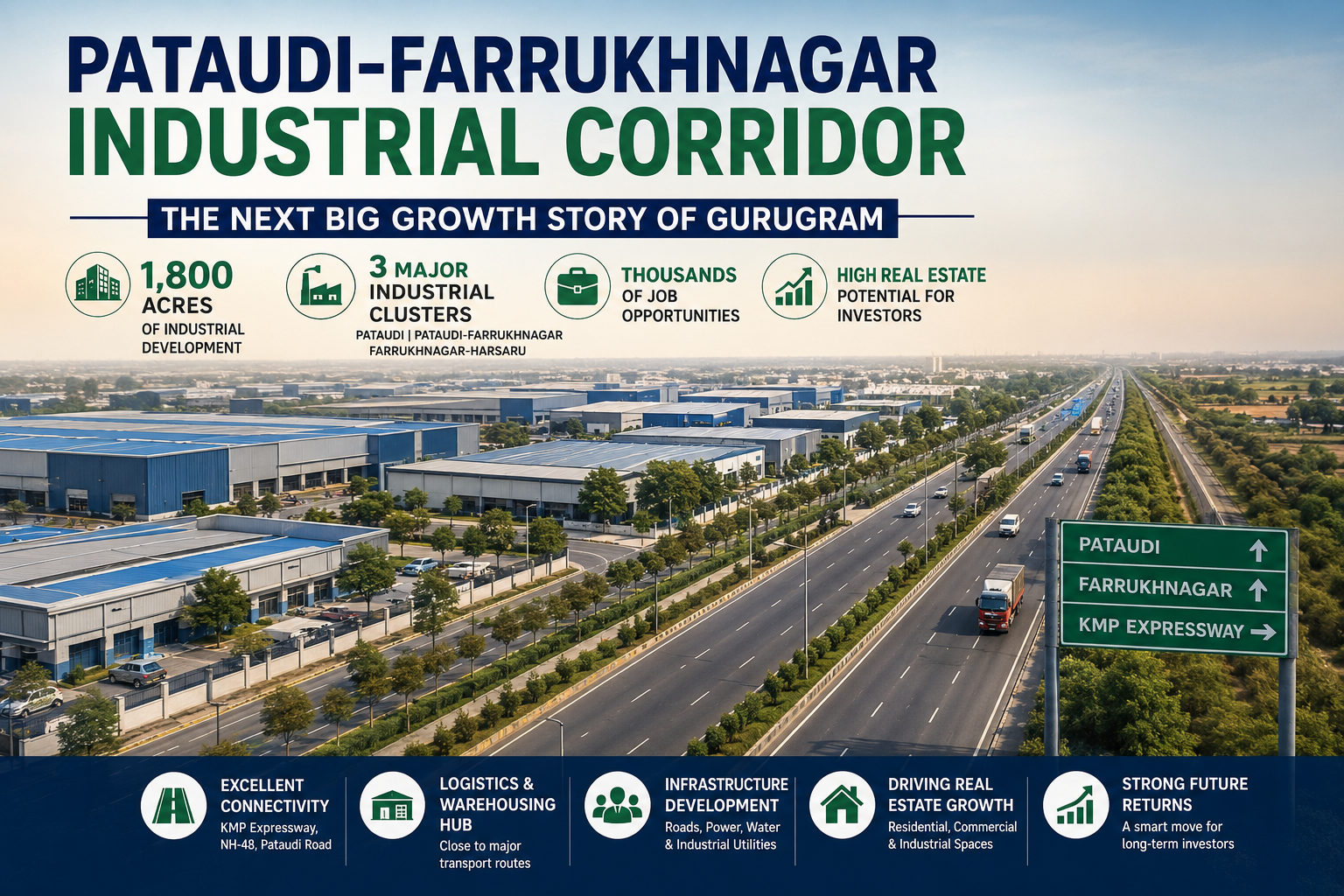
Gurugram has established itself as one of India’s leading corporate, commercial and real estate destinations. However, the city’s next phase of growth is increasingly moving beyond its traditional urban centres. One of the areas attracting growing attention is the Pataudi-Farrukhnagar Industrial Corridor.
The Haryana State Industrial and Infrastructure Development Corporation (HSIIDC) has identified around 1,800 acres across nearly 12 villages for the development of three new industrial areas in the Gurugram district. The proposed clusters are planned around Pataudi, the Pataudi-Farrukhnagar belt and Farrukhnagar-Harsaru.
This proposed industrial expansion could have implications far beyond manufacturing. Industrial development generally creates demand for transportation, warehousing, commercial spaces, rental housing and supporting services. As a result, the Pataudi-Farrukhnagar Industrial Corridor could become an important growth zone for Gurugram over the coming years.
But what exactly is planned, why is this location important, and what could it mean for the region’s real estate market?
Let’s explore.
What Is the Pataudi-Farrukhnagar Industrial Corridor?
The Pataudi-Farrukhnagar Industrial Corridor refers to an emerging industrial and economic belt connecting the Pataudi and Farrukhnagar regions of Gurugram district.
The latest industrial development plan involves approximately 1,800 acres divided into three proposed clusters:
| Proposed Industrial Cluster | Approx. Area | Expected Focus |
|---|---|---|
| Pataudi Industrial Area | 750 acres | Manufacturing and allied industries |
| Pataudi-Farrukhnagar Cluster | 500 acres | Larger industries and logistics |
| Farrukhnagar-Harsaru Cluster | 550 acres | Logistics and industrial activity |
According to reports, the Pataudi cluster is expected to include land around Rampur, Janoula, Jhori and Jatola, while the Pataudi-Farrukhnagar cluster covers areas including Jatola, Taj Nagar and Saampka. The third cluster is planned around the Farrukhnagar-Harsaru belt.
The land acquisition process is planned through Haryana’s e-Bhoomi portal, allowing participating landowners to offer land directly to the government.
This is significant because the project represents a planned expansion of Gurugram’s industrial footprint beyond established locations such as Manesar.
Why Is Pataudi-Farrukhnagar Important for Gurugram?
The importance of the Pataudi-Farrukhnagar Industrial Corridor comes from its strategic location and its potential to connect industrial, logistics and residential growth.
Gurugram’s existing commercial and industrial areas have already experienced significant development. As land becomes more expensive and urbanisation increases, peripheral areas with better land availability can become attractive for large-scale industrial and logistics projects.
The Pataudi-Farrukhnagar belt provides an opportunity to develop new industrial clusters while supporting the broader expansion of Gurugram towards its western and southwestern edges.
The proposed industrial clusters are also expected to improve infrastructure in surrounding areas, including roads, power and industrial utilities.
This combination of industrial development + infrastructure investment + employment generation could create a new economic ecosystem.
1,800 Acres Could Create a Major Industrial Ecosystem
The scale of the proposal is one of its biggest attractions.
Approximately 1,800 acres is a substantial land parcel for industrial development. Instead of a single industrial estate, the plan involves three separate clusters with different roles.
The 750-acre Pataudi cluster is expected to accommodate small and medium manufacturing units and allied industries.
The approximately 500-acre Pataudi-Farrukhnagar cluster is positioned to attract larger industries and logistics-related businesses.
Meanwhile, the approximately 550-acre Farrukhnagar-Harsaru cluster could strengthen logistics connections with surrounding industrial areas.
If implemented successfully, these clusters could create an interconnected industrial ecosystem rather than isolated industrial pockets.
How Industrial Development Can Impact Real Estate
One of the most important questions for property investors is: What does industrial development mean for real estate?
The answer lies in the relationship between employment and housing demand.
When new industries establish operations in an area, they require employees. Those employees need homes, rental accommodation, retail stores, restaurants, healthcare facilities, schools and other services.
This can create a multiplier effect:
Industrial Development → Jobs → Population Growth → Housing Demand → Commercial Growth → Infrastructure Development
This pattern has already been visible in various parts of the NCR where industrial and employment centres have supported surrounding residential development.
Therefore, the Pataudi-Farrukhnagar Industrial Corridor could gradually influence nearby residential and commercial markets.
However, investors should remember that proposed infrastructure does not automatically guarantee property appreciation. Actual returns depend on execution, connectivity, approvals, market demand and development timelines.
Pataudi Could Become an Emerging Real Estate Destination
Pataudi has traditionally been less urbanised than core Gurugram. The proposed industrial development could change the area’s economic profile.
With a 750-acre industrial cluster proposed around Pataudi, the region could attract manufacturing units, small businesses and supporting industries.
As employment opportunities increase, demand for nearby housing could gradually rise.
This could create opportunities across multiple real estate segments, including:
- Residential plots
- Builder floors
- Apartments
- Affordable housing
- Rental properties
- Commercial shops
- Warehousing
- Industrial plots
- Small commercial offices
The important point is that real estate growth would likely happen progressively as industrial activity moves from planning to actual implementation.
Farrukhnagar’s Role in the Growth Story
Farrukhnagar is another important part of this emerging corridor.
The proposed Farrukhnagar-Harsaru industrial cluster, covering around 550 acres, is expected to support logistics and strengthen connections with surrounding industrial zones.
Farrukhnagar’s location also makes it relevant from a logistics perspective. As manufacturing and distribution networks expand around Gurugram, demand for warehouses, transportation facilities and supply-chain services can increase.
This could potentially encourage the development of:
- Warehousing facilities
- Logistics parks
- Transport services
- Industrial support businesses
- Commercial centres
- Worker accommodation
- Service-sector businesses
For real estate, logistics-led growth can be particularly important because large-scale warehouses and industrial facilities often require supporting commercial and residential infrastructure.
Connectivity Could Be a Major Growth Driver
Infrastructure and connectivity are among the most important factors determining the success of any industrial corridor.
The Pataudi-Farrukhnagar belt benefits from its position within the broader Gurugram-NCR transportation network, including access toward the Kundli-Manesar-Palwal (KMP) Expressway and other major road networks.
The proposed industrial clusters have been described as strategically positioned near major highways and existing industrial belts.
For manufacturers and logistics companies, connectivity can reduce transportation time and improve access to suppliers, warehouses and consumer markets.
For residential real estate, better connectivity can make peripheral locations more attractive to employees working in nearby industrial and commercial hubs.
Employment Generation Could Boost Local Demand
Industrial development is not only about factories and warehouses. It can also create a wider employment ecosystem.
New industrial areas can generate opportunities across:
- Manufacturing
- Logistics
- Transportation
- Engineering
- Maintenance
- Packaging
- Security
- Retail
- Hospitality
- Food services
- Construction
- Professional services
The government has stated that the proposed industrial development is aimed at attracting investment and generating direct and indirect employment opportunities.
As employment increases, the population surrounding the industrial corridor can also grow.
That can create additional demand for residential and commercial properties.
Infrastructure Development Could Accelerate the Transformation
Industrial projects require reliable infrastructure.
Roads, electricity, water supply, drainage, telecommunications and other utilities are essential for industrial operations.
According to reports, infrastructure such as roads, power supply and industrial utilities is expected to be upgraded around the proposed industrial clusters.
This infrastructure investment could benefit not only industrial businesses but also surrounding communities.
Better roads can reduce travel times. Improved utilities can support businesses. Increased economic activity can encourage commercial development.
Over time, these factors can contribute to the transformation of previously peripheral areas into more organised economic centres.
The Corridor Could Support Gurugram’s Decentralised Growth
Gurugram’s rapid growth has traditionally been concentrated around areas such as Golf Course Road, Cyber City, MG Road, Sohna Road and Manesar.
The next phase could involve greater decentralisation.
The Pataudi-Farrukhnagar Industrial Corridor is part of a broader trend in which economic activity moves towards peripheral areas where larger land parcels are available.
This can help distribute employment and investment more evenly across the district.
Instead of concentrating all economic activity in central Gurugram, industrial clusters can create new employment centres closer to developing residential areas.
What Could Happen to Commercial Real Estate?
Industrial growth can also create demand for commercial real estate.
As companies enter the region, employees and businesses require supporting services.
Potential commercial opportunities could include:
- Retail shops
- Restaurants and cafes
- Clinics
- Banks and financial services
- Small offices
- Business centres
- Hotels
- Convenience stores
- Automotive services
This means the real estate impact of the Pataudi-Farrukhnagar Industrial Corridor could extend beyond residential properties.
Commercial development may gradually follow industrial and residential growth.
Warehousing and Logistics Could Be Major Beneficiaries
Among the most interesting opportunities could be logistics and warehousing.
Modern supply chains require strategically located warehouses close to highways, manufacturing facilities and major consumption markets.
The proposed industrial clusters around Pataudi, Farrukhnagar and Harsaru could strengthen the logistics ecosystem in this part of Gurugram.
Growing e-commerce, manufacturing and organised retail could further support demand for efficient storage and distribution facilities.
This makes the corridor worth watching not only for residential property buyers but also for investors interested in industrial and commercial real estate.
Is Pataudi-Farrukhnagar the Next Big Investment Opportunity?
The answer depends on the investor’s timeline and risk appetite.
The corridor has several positive development signals:
1. Large-scale industrial planning
Around 1,800 acres have been identified for three proposed industrial areas.
2. Employment potential
New industrial clusters could create significant direct and indirect employment.
3. Infrastructure development
Industrial expansion is expected to be accompanied by improvements in roads, power and utilities.
4. Logistics potential
The location’s relationship with major highways and surrounding industrial areas supports logistics activity.
5. Residential demand potential
A larger employment base could create demand for nearby housing and rental properties.
However, investors should conduct due diligence before purchasing property. A proposed project is not the same as a completed project, and timelines can change.
What Should Property Buyers Look For?
Anyone considering property around the Pataudi-Farrukhnagar Industrial Corridor should focus on fundamentals rather than simply buying based on future-growth claims.
Important factors include:
Location
Check the property’s actual distance from planned industrial zones and major roads.
Legal Approvals
Verify ownership, title, zoning, licences and applicable development permissions.
Connectivity
Consider existing road connectivity rather than relying only on proposed infrastructure.
Development Status
Understand whether a project is proposed, approved, under acquisition, under construction or operational.
Developer Reputation
For residential or commercial projects, investigate the developer’s track record.
Long-Term Demand
Look at employment centres, infrastructure and population growth rather than short-term speculation.
These factors can help investors differentiate between genuine opportunities and marketing hype.
Future Outlook for the Pataudi-Farrukhnagar Industrial Corridor
The Pataudi-Farrukhnagar Industrial Corridor has the potential to become an important component of Gurugram’s long-term expansion.
The proposed 1,800-acre industrial development represents a significant attempt to expand the district’s manufacturing and logistics ecosystem. The three-cluster approach could help create a more diversified economic base around Pataudi, Farrukhnagar and Harsaru.
If implementation progresses as planned, the corridor could gradually attract industries, workers, logistics operators, service providers and real estate developers.
The resulting ecosystem could transform the region from a relatively peripheral belt into a more integrated economic zone.
Conclusion
The Pataudi-Farrukhnagar Industrial Corridor could become one of the more closely watched growth corridors in Gurugram.
With approximately 1,800 acres identified for three industrial clusters, the initiative has the potential to strengthen manufacturing, logistics, employment and infrastructure in the region.
For the real estate market, the bigger story is the potential multiplier effect. Industrial activity can create jobs, jobs can increase housing demand, and rising population can support retail and commercial development.
That does not mean every property in the area will automatically appreciate. Investors need to evaluate location, approvals, infrastructure, development timelines and actual demand carefully.
But from a long-term perspective, the Pataudi-Farrukhnagar Industrial Corridor is certainly a development worth watching as Gurugram continues to expand beyond its traditional boundaries.
Frequently Asked Questions
1. What is the Pataudi-Farrukhnagar Industrial Corridor?
It is an emerging industrial growth belt connecting the Pataudi and Farrukhnagar areas of Gurugram, with proposed industrial clusters planned by HSIIDC.
2. How much land is planned for industrial development?
Around 1,800 acres across nearly 12 villages have been identified for three proposed industrial areas.
3. What are the three proposed industrial clusters?
The plan includes approximately 750 acres around Pataudi, 500 acres along the Pataudi-Farrukhnagar corridor and 550 acres around Farrukhnagar-Harsaru.
4. Can the corridor impact Pataudi real estate?
Potentially, yes. Industrial employment and infrastructure development can create additional demand for housing, rentals and commercial services. However, actual market performance will depend on project execution and demand.
5. Is Pataudi-Farrukhnagar a good area for future investment?
It may offer long-term potential, but investors should verify property approvals, title, location, infrastructure and the actual status of proposed developments before making a decision.
6. Why is Farrukhnagar important for logistics?
Its position within the wider Gurugram transportation and industrial network makes it relevant for logistics, warehousing and supporting industries. The proposed Farrukhnagar-Harsaru cluster is specifically expected to strengthen the logistics network.