How Haryana RERA’s Four-Month Extension Will Impact Real Estate Projects
The real estate sector is closely connected to global supply chains, construction materials, labour availability and transportation networks. When geopolitical disruptions affect these factors, developers can face unexpected challenges in completing projects within their originally approved timelines.
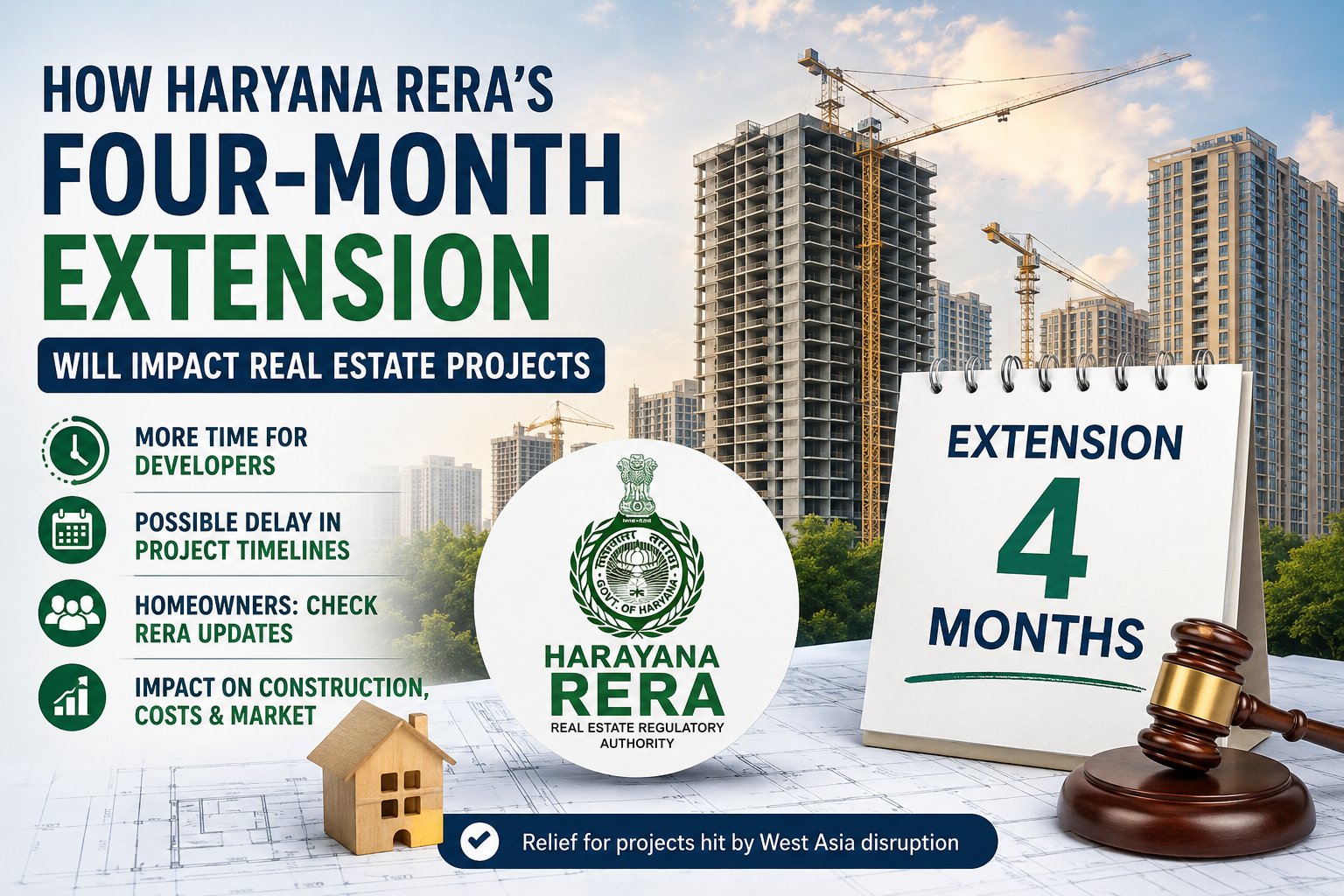
Against this backdrop, the Haryana Real Estate Regulatory Authority (Haryana RERA) has granted a four-month extension to eligible real estate projects affected by disruptions arising from the West Asia conflict. The move follows an advisory from the Ministry of Housing and Urban Affairs encouraging state RERA authorities to consider relief for projects facing genuine delays linked to the international situation.
The decision is particularly significant for Haryana because Gurugram is one of India’s major real estate markets, with large residential, commercial and mixed-use developments under construction.
But what exactly does the four-month extension mean? Will it automatically delay possession? How will developers benefit? And what should homebuyers know before making decisions?
Let’s understand how Haryana RERA’s four-month extension will impact real estate projects and what it could mean for Haryana’s property market.
What Is the Haryana RERA Four-Month Extension?
The four-month extension is intended to provide relief to eligible projects whose construction schedules have been affected by disruptions connected with the West Asia situation.
The conflict has created uncertainty across international supply chains, affecting the movement and availability of certain construction-related materials and logistics. According to reports, Haryana RERA’s decision is aimed at giving developers additional time where project delays can reasonably be linked to these external disruptions.
It is important to understand that this should not simply be interpreted as a blanket permission for every delayed project to extend its completion timeline without scrutiny.
Haryana RERA has historically required promoters to meet stipulated conditions and timelines. Its project orders show that where promoters receive conditional timelines, failure to comply can lead to consequences, including forfeiture of security amounts and further action under the RERA framework.
Therefore, the key issue is whether a project genuinely qualifies for relief and whether the delay is connected to the circumstances covered by the extension.
Why Was an Extension Considered Necessary?
Real estate construction involves a complex network of suppliers, contractors, logistics providers and regulatory approvals.
A disruption in one part of this chain can affect several other activities.
For example, a developer may face:
- Delays in receiving construction materials
- Higher transportation and logistics costs
- Disruptions in international supply chains
- Difficulty sourcing specific imported components
- Increased construction costs
- Delays in procurement schedules
- Uncertainty around contractor timelines
The West Asia conflict has added another layer of uncertainty to global trade and logistics. For projects already under construction, even a relatively short disruption can have a larger impact because construction activities are interconnected.
For this reason, the four-month relief period can give qualifying developers some additional flexibility to complete affected activities rather than being penalised for delays caused by circumstances beyond their reasonable control.
How Haryana RERA’s Four-Month Extension Will Impact Real Estate Projects
1. Developers Get Additional Time to Complete Eligible Projects
The most direct impact is additional time for developers whose projects have been affected by the specified disruptions.
Large residential developments can involve multiple construction stages, including structural work, electrical systems, plumbing, finishing, external development and infrastructure.
If the supply of a critical material is disrupted, subsequent activities can also be pushed back.
The extension can therefore help developers reorganise construction schedules and complete pending work without the immediate pressure of an approaching regulatory deadline.
However, developers should still maintain proper project records and demonstrate that delays are genuinely connected to the circumstances covered by the relief.
2. Possession Timelines Could Be Affected
One of the biggest concerns for homebuyers is whether the four-month extension will automatically result in delayed possession.
The answer depends on the specific project and the nature of the relief applicable to it.
Where an eligible project receives an extension to its regulatory completion timeline, the revised timeline could influence the expected completion or possession schedule.
However, buyers should not assume that every project in Haryana automatically gets four additional months.
The project’s RERA registration details, approved timeline, extension order and applicable conditions should be checked carefully.
This distinction is important because RERA is designed to bring transparency and accountability to real estate transactions.
3. Homebuyers May Need to Reassess Their Possession Expectations
For buyers waiting for their homes, even a few additional months can have financial implications.
A possession delay can affect:
- Rental expenses
- Home-loan interest
- Interior planning
- Relocation plans
- School or workplace arrangements
- Investment strategies
Therefore, homebuyers should obtain updated information directly from the developer and verify the project’s regulatory status.
Instead of relying only on marketing announcements, buyers should check the official RERA records for the project’s latest approved timeline and relevant orders.
The official Haryana RERA portal provides project-level information and records of regulatory proceedings.
4. Construction Activity Could Become More Stable
An extension can also have a positive impact on construction planning.
Developers facing supply-chain uncertainty may be able to reorganise procurement schedules, identify alternative suppliers and adjust construction programmes.
Rather than rushing construction activities simply to meet an original deadline, developers can use the additional time to complete work in a more structured manner.
For homebuyers, this could be beneficial if the additional time contributes to better-quality construction and smoother completion.
The objective should therefore be viewed as time relief for genuine disruption rather than a substitute for project execution.
5. Construction Costs May Remain a Concern
Geopolitical uncertainty can influence commodity prices, transportation expenses and procurement costs.
For real estate developers, higher costs can put pressure on project finances.
Construction projects typically involve significant expenditure on materials, labour, equipment and logistics. A prolonged disruption can increase the cost of delivering the same project.
The four-month extension can provide additional time, but it does not necessarily eliminate these cost pressures.
Developers will still need to manage project finances carefully while ensuring that construction progresses according to the revised schedule.
6. The Impact on Gurugram Real Estate Could Be Significant
Gurugram is one of the most important real estate markets in Haryana.
The city has experienced substantial development across corridors such as:
- Dwarka Expressway
- Golf Course Extension Road
- Southern Peripheral Road
- New Gurgaon
- Golf Course Road
- Sohna Road
A large number of residential and commercial projects are under development across these areas.
Consequently, any regulatory decision affecting project timelines can have a wider impact on developers, investors and homebuyers.
For investors, the key consideration will be whether a project’s underlying fundamentals remain strong despite temporary construction or supply-chain challenges.
7. Buyers Should Pay More Attention to RERA Records
The latest development highlights why buyers should verify RERA information before purchasing property.
Before booking a home, buyers should review:
- RERA registration number
- Promised completion date
- Latest project progress
- Quarterly project updates
- Extension orders, if any
- Developer’s compliance history
- Litigation or regulatory proceedings
- Construction status
- Approved project plans
- Payment schedule
Haryana RERA’s publicly available project records demonstrate that project approvals and compliance requirements can include specific deadlines and conditions.
This makes independent verification especially important when a project is being marketed with revised completion timelines.
8. Not Every Delay Should Be Treated as a West Asia-Related Delay
This is perhaps the most important point for homebuyers.
The four-month extension should not be interpreted as a general excuse for every delay in construction.
Real estate projects can experience delays for many reasons, including:
- Financial difficulties
- Approval delays
- Land-related disputes
- Contractor issues
- Poor project management
- Regulatory violations
- Insufficient construction resources
These are not automatically equivalent to delays caused by an external geopolitical disruption.
Haryana RERA’s past proceedings show that the authority can scrutinise compliance and impose consequences when stipulated requirements are not met.
Therefore, buyers should distinguish between a legitimate regulatory extension and an unexplained project delay.
What Does the Extension Mean for Real Estate Developers?
For developers, the decision offers several potential benefits.
Better Construction Planning
Additional time can help developers adjust procurement and construction schedules.
Reduced Regulatory Pressure
Eligible developers may have greater flexibility where delays are directly connected to covered external disruptions.
Improved Project Execution
A revised timeline can allow construction teams to address supply-chain issues without compromising execution quality.
Better Risk Management
Developers can use the additional period to manage logistics, procurement and contractor coordination more effectively.
However, the extension also comes with an important responsibility: developers need to maintain transparency with buyers and comply with applicable RERA requirements.
What Does It Mean for Homebuyers?
For homebuyers, the impact is more nuanced.
The extension can be positive if it helps a genuine project overcome temporary supply-chain problems and reach completion.
At the same time, buyers may have to accommodate a longer waiting period where the revised regulatory timeline affects possession.
Homebuyers should therefore ask the developer:
- Has the project received the four-month extension?
- What was the original completion date?
- What is the revised completion date?
- What specific disruption caused the delay?
- Is the extension recorded with Haryana RERA?
- What percentage of construction has been completed?
- Is the project currently progressing according to schedule?
Getting these details in writing is preferable to relying solely on verbal assurances.
Will the Extension Affect Property Prices in Haryana?
The extension itself is unlikely to determine property prices.
Property prices in Haryana, particularly in Gurugram, are influenced by several factors, including:
- Location
- Infrastructure development
- Demand and supply
- Employment growth
- Connectivity
- Developer reputation
- Project quality
- Interest rates
- Construction progress
- Overall economic conditions
The four-month extension is primarily a regulatory and project-completion measure.
If it helps developers complete projects efficiently, it could support market stability. Conversely, if construction delays become prolonged, buyer sentiment could be affected.
Therefore, the long-term effect will depend more on how developers use the additional time than on the extension itself.
Is This Extension Good for the Haryana Real Estate Market?
Overall, the extension can be viewed as a temporary relief mechanism for genuine external disruptions.
It provides developers with breathing room while recognising that international events can affect local construction activity.
At the same time, the interests of homebuyers remain important.
The effectiveness of the measure will depend on three factors:
Transparency: Buyers should clearly understand revised project timelines.
Accountability: Developers should demonstrate that delays are genuinely connected to the covered disruptions.
Execution: The additional four months should ultimately translate into measurable construction progress.
If these three factors are maintained, the extension could help stabilise affected projects without weakening the broader objectives of RERA.
What Should Property Investors Do in 2026?
Investors should avoid making decisions based solely on short-term headlines.
Instead, they should evaluate individual projects based on their fundamentals.
A project with strong construction progress, good connectivity, reputable developers and valid RERA registration may continue to remain attractive despite temporary disruptions.
On the other hand, projects with a history of delays, weak financial execution or unresolved regulatory issues require greater caution.
The four-month extension should therefore be treated as one factor in the investment decision—not the entire investment thesis.
Conclusion
The Haryana RERA four-month extension is an important development for the state’s real estate sector, particularly for projects affected by disruptions associated with the West Asia situation.
The measure can provide eligible developers with additional time to manage supply-chain challenges, complete construction and adjust project schedules. At the same time, it could affect possession expectations for some homebuyers.
For buyers, the key takeaway is simple: do not assume that every delayed project automatically qualifies for the extension.
Check the project’s RERA registration, revised timeline, regulatory orders and actual construction progress before making a decision.
For developers, the extension provides an opportunity to use additional time productively and demonstrate that genuine disruptions can be managed without compromising transparency or accountability.
As Haryana’s real estate market continues to expand, particularly across Gurugram and the wider Delhi-NCR region, regulatory measures such as this will remain important in balancing developer challenges with homebuyer protection.
Ultimately, the real impact of Haryana RERA’s four-month extension will depend on how effectively eligible developers use the additional time to convert temporary relief into actual project completion.