Gurugram Global City’s 700-Metre Tower: What It Means for India’s Skyline
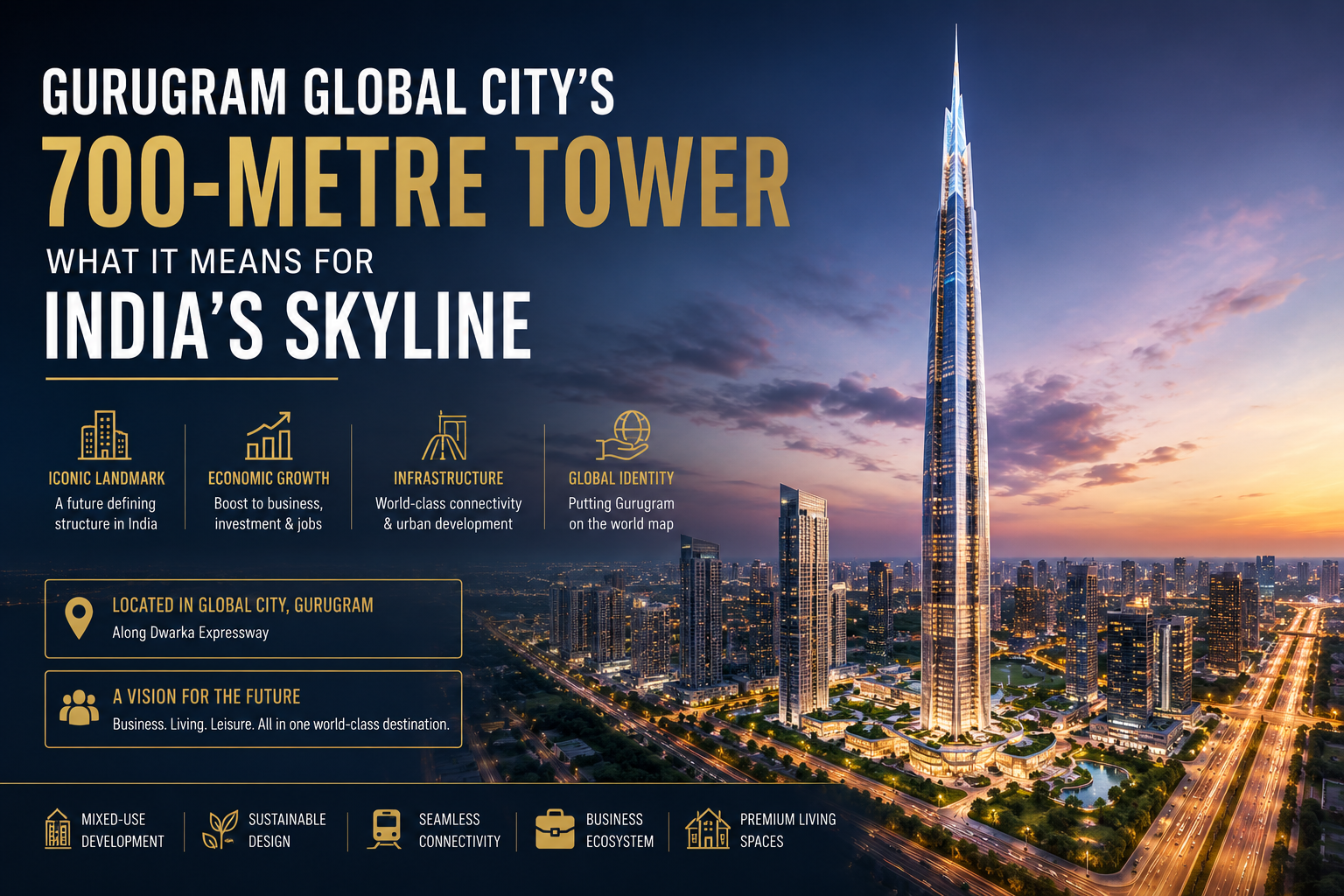
Gurugram has evolved from a satellite city of Delhi into one of India’s most important corporate, commercial and real estate destinations. Now, the city could be preparing for another major transformation with the proposed Gurugram Global City 700-metre tower.
The Haryana government has identified a 6.7-acre plot within the Global City development for a proposed mixed-use tower with a height of approximately 620 to 700 metres. If developed at the upper end of the proposed range, the structure could become India’s tallest building by a significant margin.
However, it is important to understand that the tower is currently a proposal/planning-stage development, rather than a completed or under-construction building. The final height, design, development structure and construction timeline are yet to be confirmed.
Beyond its height, the proposed landmark could have a much broader significance. It may influence Gurugram’s skyline, commercial real estate market, infrastructure requirements, tourism appeal and India’s position in the global architecture and business landscape.
So, what could the Gurugram Global City 700-metre tower actually mean for India?
What Is the Gurugram Global City 700-Metre Tower?
The proposed tower is part of the larger Global City Gurugram, an ambitious mixed-use urban development being implemented by the Haryana State Industrial and Infrastructure Development Corporation (HSIIDC).
According to the Global City project’s official information, the development covers more than 1,000 acres across parts of Sectors 36, 36B, 37 and 37B and is positioned as a future Central Business District for Gurugram. It is planned around modern technology, green infrastructure, transit-oriented development and a live-work-play environment.
The proposed tower would therefore not be an isolated skyscraper. It would become part of a much larger urban ecosystem containing commercial, residential, institutional, hospitality, retail and recreational components.
Reports in June 2026 stated that a 6.7-acre plot had been earmarked for the proposed 620–700-metre mixed-use tower. The project could potentially include commercial, hospitality, retail and residential components, although final specifications have not yet been announced.
Why Is a 700-Metre Tower Significant?
Height matters when discussing global cities, but the significance of a skyscraper goes beyond the number of metres.
A 700-metre structure would place Gurugram among a very small group of cities associated with mega-tall architecture. For comparison, Mumbai’s Palais Royale, currently India’s tallest completed building, is around 320 metres. A 620–700-metre Global City tower would therefore be roughly twice as tall as India’s current tallest building.
At 700 metres, the proposed tower would also approach the scale of some of the world’s most famous skyscrapers.
That could give Gurugram a new visual identity.
Instead of being known primarily for corporate offices, technology companies and modern residential developments, the city could increasingly be associated with an internationally recognised architectural landmark.
How Could It Transform Gurugram’s Skyline?
The most immediate impact would be visual.
Gurugram’s skyline has already changed dramatically over the last two decades. High-rise residential towers, corporate buildings and commercial developments have transformed the city’s landscape.
A 700-metre landmark, however, would represent a completely different scale.
1. Creating a New City Landmark
The proposed tower could become a defining visual symbol of Gurugram.
Iconic buildings often become strongly associated with their cities. The Burj Khalifa is closely associated with Dubai, the Empire State Building with New York and the Shanghai Tower with Shanghai.
Similarly, a successful Global City tower could become a visual representation of modern Gurugram.
2. Putting Gurugram on the Global Architecture Map
India has several impressive skyscrapers, but it does not yet have a building that competes with the world’s most famous mega-tall structures in terms of height.
If the proposed tower reaches close to 700 metres, it could change that narrative.
It could attract international attention from architects, developers, investors, businesses and tourists.
3. Creating a Stronger Sense of Place
A landmark tower can also help establish the identity of a new business district.
Global City is envisioned as a future Central Business District rather than simply another residential development. Its official plans include commercial spaces, residential towers, retail, hospitality, green areas and multi-modal connectivity.
The iconic tower could become the centrepiece of this broader urban identity.
Global City Gurugram: More Than Just a Skyscraper
It is important not to look at the Gurugram Global City 700-metre tower separately from the wider Global City project.
The official Global City website describes the development as a self-sufficient Central Business District with a focus on modern technology, low-carbon infrastructure and transit-oriented development.
The planned development includes approximately 12.88 million square metres of built-up area, covering office spaces, residential towers, hospitals, hotels, exhibition and convention facilities and retail uses.
This means the real transformation could come from the combination of:
- A landmark mega-tall tower
- Commercial and office districts
- Residential developments
- Hospitality
- Retail
- Healthcare and institutional facilities
- Green and open spaces
- Public transportation
- Walk-to-work planning
- Technology-focused infrastructure
Together, these elements could create a new business ecosystem in Gurugram.
The Role of Dwarka Expressway
One of the biggest advantages of Global City is its location.
The project has direct accessibility from the 8-lane Dwarka Expressway, while NH-48 and the Central Peripheral Road are also nearby. The official project documents also highlight its connectivity through Pataudi Road and planned transit infrastructure.
This connectivity could be crucial for a landmark tower.
A building of this scale cannot function effectively without strong transportation infrastructure. Thousands of employees, residents, visitors and tourists could potentially use the surrounding roads and public transport network.
Therefore, the development of the tower could also accelerate conversations around:
- Metro connectivity
- Public transport
- Road capacity
- Parking management
- Pedestrian infrastructure
- Cycling infrastructure
- Traffic management
- Airport connectivity
In other words, the skyscraper could act as a catalyst for broader infrastructure improvements.
Impact on Gurugram Real Estate
The proposed tower could also influence the real estate market around Global City and the wider Dwarka Expressway corridor.
A major international business district generally attracts several types of real estate demand.
Commercial Real Estate
A landmark tower could increase the visibility of Global City as a corporate destination.
International companies, Indian corporations, financial services firms, technology businesses and professional services companies could potentially be attracted to a high-profile business district.
This could create demand for:
- Grade-A office spaces
- Retail
- Hotels
- Serviced apartments
- Business centres
- Restaurants
- Entertainment spaces
Residential Real Estate
As employment opportunities increase, residential demand could also rise in surrounding areas.
Professionals generally prefer living closer to employment hubs when connectivity and amenities are strong.
The Global City concept itself follows a live-work-play approach, with residential and commercial uses planned within the same broader development.
This could reduce the traditional separation between residential and employment zones.
Investment Potential
A landmark project can also increase investor attention.
However, investors should distinguish between potential future impact and guaranteed appreciation.
The 700-metre tower is still at the planning/proposal stage, and its final specifications and timeline remain uncertain. Therefore, property investment decisions should not depend solely on the assumption that the tower will definitely be completed at 700 metres.
Could It Compete With Cyber City?
Gurugram already has an established commercial hub in Cyber City.
Global City could eventually create another major business district with a different urban model.
Cyber City developed as a major corporate destination with office towers, restaurants, retail and entertainment. Global City is being planned on a larger integrated model, combining business, residential, institutional and lifestyle uses.
This could create an interesting evolution:
Cyber City → Established Corporate Hub
Global City → Future Integrated Business & Lifestyle District
Rather than completely replacing Cyber City, Global City could complement it and increase Gurugram’s overall commercial capacity.
Sustainability Will Be Critical
A 700-metre tower would require enormous amounts of energy, water, transportation and supporting infrastructure.
Therefore, the success of the project should not be measured only by its height.
It should also be evaluated by how efficiently it manages:
- Energy consumption
- Water management
- Waste
- Cooling systems
- Public transportation
- Renewable energy
- Green spaces
- Carbon emissions
- Pedestrian movement
The Global City project itself places emphasis on low-carbon green infrastructure, expansive green spaces and transit-oriented development.
This approach could become particularly important if Gurugram wants the project to represent a modern global city rather than simply another cluster of high-rise buildings.
Infrastructure Will Determine Its Success
Building a 700-metre tower is an engineering challenge, but creating a successful district around it may be an even bigger urban-planning challenge.
A mega-tall building requires:
- High-capacity elevators
- Advanced fire safety systems
- Emergency evacuation planning
- Reliable power
- Water supply
- Waste management
- Strong structural engineering
- High-speed connectivity
- Efficient traffic management
The wider Global City development also needs supporting infrastructure to operate effectively.
Recent government directions have focused on completing essential infrastructure such as power and water supply and preparing a blueprint for a world-class iconic tower in Global City.
This shows why infrastructure and the tower’s development need to progress together.
Could the Tower Boost Tourism?
The tower could potentially become a new attraction for Gurugram and the wider Delhi-NCR region.
If the final design includes publicly accessible spaces, observation facilities, restaurants, hospitality or entertainment components, it could attract visitors beyond office workers and residents.
That could create opportunities for:
- Tourism
- Hospitality
- Restaurants
- Retail
- Events
- Conferences
- Entertainment
- Corporate experiences
The Global City master plan already envisions hospitality and exhibition/convention facilities, creating the possibility of a broader visitor economy.
What Does It Mean for India’s Skyline?
The biggest significance of the Gurugram Global City 700-metre tower may be symbolic.
India is rapidly urbanising and developing globally competitive business districts. A mega-tall tower in Gurugram would demonstrate that Indian cities are increasingly willing to experiment with large-scale vertical development.
It could represent a shift from simply constructing tall buildings toward creating globally recognisable urban destinations.
If successfully delivered, the project could strengthen India’s presence in the international skyscraper landscape.
But the real achievement would not be simply breaking a height record.
The real achievement would be creating a well-connected, sustainable and economically productive district around the landmark.
What Should Investors and Buyers Watch?
Anyone interested in the Gurugram real estate market should monitor several developments before making decisions based on Global City.
1. Final Tower Design
The proposed height currently ranges from approximately 620 to 700 metres. The final height and architectural design are not yet confirmed.
2. Development Timeline
The tower remains a future development proposal, so buyers should avoid assuming an immediate construction or completion date.
3. Infrastructure Progress
Power, water, roads and public transportation will be critical to the success of Global City.
4. Commercial Occupancy
The long-term impact on property values will depend partly on how successfully Global City attracts businesses and employees.
5. Connectivity
Future road and transit improvements could significantly influence accessibility and demand around the project.
The Future of Gurugram Could Be Taller, Smarter and More Global
The proposed Gurugram Global City 700-metre tower is more than a discussion about India’s tallest building.
It is part of a much larger vision for Gurugram—one that combines business, technology, residential development, hospitality, retail, infrastructure and sustainable urban planning.
The Global City project already covers more than 1,000 acres and is planned as a future Central Business District along the Dwarka Expressway.
If the proposed tower is ultimately developed at close to 700 metres, it could become a powerful symbol of Gurugram’s transformation from a corporate satellite city into a globally recognised business destination.
At the same time, expectations should remain realistic. The tower is still at the proposal/planning stage, and its final height, design, execution timeline and development structure can change.
For India, however, the ambition itself is significant.
The future of India’s skyline may not be limited to Mumbai or Delhi. Gurugram could soon become one of the country’s most important symbols of modern vertical development.
Frequently Asked Questions
How tall will the Gurugram Global City tower be?
The proposed tower is currently reported to be approximately 620 to 700 metres tall. The final height has not yet been confirmed.
Will the Gurugram Global City tower be India’s tallest building?
If completed at the proposed height, it could become India’s tallest building by a significant margin. India’s current tallest completed building, Mumbai’s Palais Royale, is around 320 metres.
Where will the 700-metre tower be located?
The proposed tower is planned within Gurugram’s Global City development, which is located along the Dwarka Expressway across parts of Sectors 36, 36B, 37 and 37B.
Is the 700-metre tower under construction?
No. The tower is currently a proposed/planned project. Its final specifications and construction timeline have not been confirmed.
How could Global City affect Gurugram real estate?
The development could increase commercial activity, employment opportunities, infrastructure investment and demand for residential, office, hospitality and retail spaces in the surrounding areas. However, actual real estate appreciation will depend on execution, connectivity, demand and broader market conditions.