India’s Metro Expansion 2026: Which Cities Are Getting New Metro Lines?
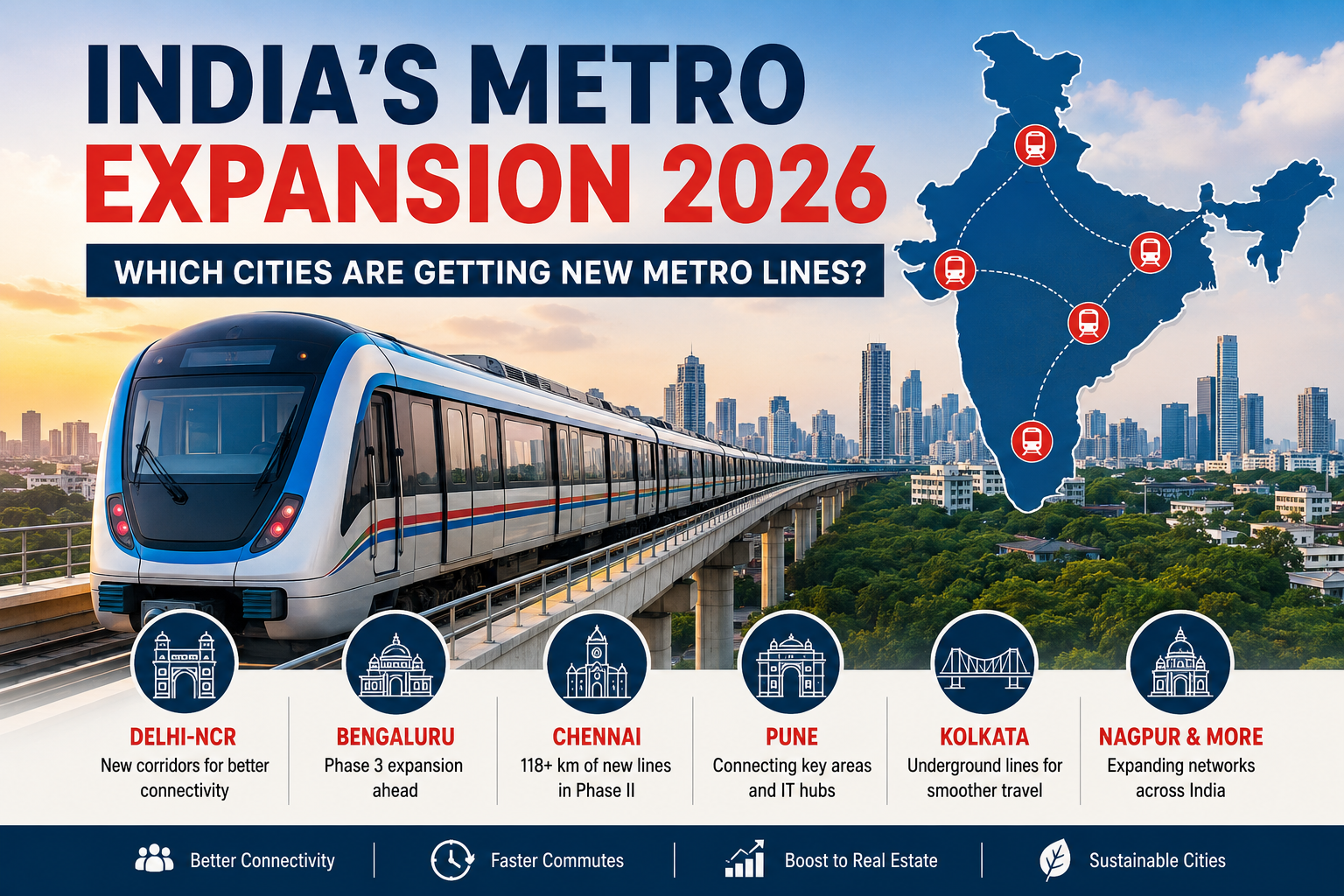
India is witnessing a major transformation in urban transportation as metro rail networks continue to expand across the country. With growing populations, increasing traffic congestion and rising demand for faster public transport, metro systems are becoming an important part of India’s infrastructure development.
The upcoming metro projects in India 2026 are expected to strengthen connectivity across major metropolitan cities as well as emerging urban centres. From Delhi-NCR and Bengaluru to Chennai, Pune, Noida and Kolkata, several metro corridors are under construction, approved or moving through different stages of development.
According to recent government data, India’s operational metro network has crossed 1,155 km and metro connectivity has expanded to 26 cities. At the same time, hundreds of kilometres of additional metro corridors are being implemented across the country.
So, which Indian cities are getting new metro lines, and how could these projects change connectivity, travel times and future development? Let’s take a closer look.
India’s Metro Expansion in 2026
The growth of metro rail in India has accelerated considerably over the last decade. The country’s metro network has expanded from around 248 km in 2014 to more than 1,155 km in 2026. The number of cities with metro connectivity has also increased from just five to 26.
This expansion is not limited to the largest cities. Metro and metro-based rapid transit projects are increasingly being planned to connect residential areas with employment hubs, airports, railway stations, educational institutions and commercial centres.
The objective is not simply to add more kilometres of railway lines. New corridors are being designed to improve last-mile connectivity, reduce dependence on private vehicles and provide faster access to major economic centres.
1. Delhi-NCR: One of India’s Biggest Metro Expansion Zones
Delhi-NCR remains one of the most important regions for metro expansion in India. With a large population spread across Delhi, Noida, Gurugram, Ghaziabad and surrounding areas, improving mass transit connectivity is a major infrastructure priority.
Delhi Metro Phase IV is one of the most significant projects in the region. The Rithala–Narela–Nathupur (Kundli) corridor, for example, is planned over 26.463 km with 21 stations. The corridor is designed to improve connectivity between north-west Delhi and neighbouring Haryana.
Several other Phase IV corridors are also progressing. Reports in 2026 indicate that important stretches including the Janakpuri West–RK Ashram Marg extension, Aerocity–Tughlakabad corridor and Majlis Park–Maujpur extension are among the major additions being targeted as part of the ongoing expansion.
Why Delhi-NCR Metro Expansion Matters
Better metro connectivity can make several peripheral and developing areas more accessible. Locations close to new stations may see improved access to employment hubs, educational institutions, commercial centres and residential neighbourhoods.
For real estate, infrastructure connectivity is often an important factor influencing the attractiveness of an area. However, actual property-price movement depends on several factors, including supply, demand, employment growth and project completion.
2. Noida and Greater Noida: Expanding the Metro Network
Noida is also becoming an important part of the NCR’s expanding urban transit network.
One major project is the Noida Sector 142 to Botanical Garden Metro extension, covering approximately 11.56 km with eight elevated stations. Once operational, the corridor is expected to improve connections between Noida’s employment areas and major interchange points at Botanical Garden.
The project is particularly relevant for commuters travelling between residential neighbourhoods, business districts and existing metro corridors.
Noida’s expanding metro network could also support the growth of commercial and residential areas along emerging corridors by making daily commuting easier.
3. Bengaluru: Major Metro Growth for India’s IT Capital
Bengaluru is another city witnessing significant metro expansion. With severe traffic congestion and a large concentration of IT and technology companies, efficient public transportation is essential for the city.
The Bengaluru Metro Phase 3 project has been approved with two corridors covering 44.65 km and 31 stations. One corridor will run from JP Nagar 4th Phase to Kempapura along Outer Ring Road West, while the second will connect Hosahalli to Kadabagere along Magadi Road.
The project is expected to strengthen connectivity across western Bengaluru and link several industrial, educational and employment areas.
Bengaluru’s wider metro expansion is particularly important because major technology and business hubs generate significant daily commuter traffic. Better metro access could help reduce road congestion and provide more predictable travel options.
4. Chennai: One of the Largest Metro Expansion Projects
Chennai has one of the most ambitious metro expansion programmes in the country.
Chennai Metro Phase II comprises three major corridors with a combined length of 118.9 km and 128 stations. The corridors include Madhavaram–SIPCOT, Light House–Poonamallee Bypass and Madhavaram–Sholinganallur.
The project is designed to improve north-south and east-west connectivity across Chennai.
Once completed, Phase II is planned to take Chennai’s total metro network to approximately 173 km. The project is also designed with multimodal integration in mind, with planned interchange points intended to make connections between different transport systems easier.
For a city experiencing rapid urban development, this kind of large-scale metro expansion could significantly change commuting patterns.
5. Pune: New Metro Corridors Connecting Fast-Growing Areas
Pune is another major city to watch when it comes to upcoming metro projects in India 2026.
The Pune Metro Phase II expansion includes the Vanaz–Chandani Chowk and Ramwadi–Wagholi/Vitthalwadi corridors. Together, these extensions cover 12.75 km and include 13 stations. The corridors are intended to connect areas such as Chandani Chowk, Bavdhan, Kothrud, Kharadi and Wagholi.
Another major Phase II approval covers the Kharadi–Hadapsar–Swargate–Khadakwasla corridor and the Nal Stop–Warje–Manik Baug corridor. Together, these corridors span 31.636 km with 28 elevated stations.
These projects could be particularly important for Pune’s IT hubs, commercial districts and rapidly developing residential areas.
6. Kolkata: Underground Metro Expansion Continues
Kolkata has also continued to expand its metro network with a combination of elevated and underground corridors.
One of the major ongoing projects is the Joka–Esplanade Metro Corridor, also known as the Purple Line. In July 2026, a tunnel boring machine achieved a breakthrough between Khidderpore and Victoria, marking an important construction milestone. The corridor is expected to improve connectivity between southern Kolkata and the city’s central business areas.
Kolkata’s metro network has expanded considerably in recent years. Government data shows that around 45 km of metro lines were commissioned in the city between 2014 and 2025, compared with 28 km during the preceding four decades.
The city is also investing in modernising its existing metro infrastructure, including new rolling stock and power-system upgrades.
7. Nagpur: Metro Expansion Beyond Phase I
Nagpur is another important city in India’s metro expansion story.
The city already has an operational metro network, while Nagpur Metro Phase II is progressing. The government has also indicated that the Detailed Project Report for Phase III has been prepared, highlighting the potential for further expansion in the future.
Nagpur’s metro development is significant because the city is emerging as an important logistics, industrial and commercial centre in central India.
Improved metro connectivity can help connect residential areas with employment zones and major transport nodes, strengthening the city’s overall urban mobility.
8. Mumbai: Metro Expansion Alongside Wider Urban Transport Projects
Mumbai’s transport network is evolving through multiple large-scale infrastructure projects.
The city has already seen major metro development, including the completion of Mumbai Metro Line 3, the fully underground Aqua Line. The 33.5 km corridor connects Cuffe Parade with Aarey JVLR and includes 27 stations.
Beyond the existing metro network, Mumbai and the wider Mumbai Metropolitan Region are also seeing proposals and extensions aimed at strengthening the integrated transit network.
For example, Mumbai Metro Line 11 has been proposed between Anik Depot and Gateway of India. The proposed underground corridor would span 17.41 km and connect important residential, commercial and institutional areas in South and Central Mumbai.
The broader Mumbai region is also receiving major suburban rail capacity upgrades, showing that the future of urban mobility will involve integration between metro, suburban rail and other public transport systems.
How Upcoming Metro Projects Could Impact Real Estate
One of the most important questions surrounding metro expansion is its potential effect on real estate.
New metro stations can make previously less-connected areas easier to access. Improved connectivity may increase interest in residential properties, offices, retail spaces and commercial developments located around major transit corridors.
However, metro connectivity alone does not guarantee property appreciation.
Factors such as:
- Distance from the metro station
- Quality of surrounding infrastructure
- Employment opportunities
- Road connectivity
- Availability of schools and healthcare
- Commercial development
- Population growth
- Project completion timeline
- Existing property supply
also influence real estate demand.
This is why investors and homebuyers should consider metro projects as part of a broader infrastructure and market analysis rather than treating a proposed metro station as an automatic guarantee of price growth.
Benefits of India’s Metro Expansion
The growing metro network can provide several benefits to Indian cities.
Reduced Traffic Congestion
Metro systems can move large numbers of passengers without requiring additional road space for every commuter. This can help reduce pressure on major roads.
Faster Commuting
Metro corridors can offer more predictable journey times, particularly on heavily congested routes.
Better Access to Employment Hubs
Connecting residential neighbourhoods with business districts and IT corridors can make employment centres more accessible.
Sustainable Urban Mobility
Metro rail can encourage public transport usage and reduce dependence on individual vehicles.
Improved Regional Connectivity
In metropolitan regions such as Delhi-NCR and Mumbai, metro and rapid transit systems can help connect multiple urban centres into a more integrated economic region.
What to Expect From India’s Metro Network in the Coming Years
The story of India’s metro expansion is moving beyond individual city projects. The focus is increasingly on creating integrated urban mobility systems.
Future networks are likely to place greater emphasis on:
- Multimodal transport integration
- Airport connectivity
- Railway station interchanges
- Last-mile connectivity
- Smart ticketing
- Modern metro trains
- Better passenger information systems
- Transit-oriented development
- Connectivity to emerging residential and commercial zones
The government’s continued investment in metro infrastructure shows that mass rapid transit will remain an important component of India’s urban development strategy.
Conclusion
The upcoming metro projects in India 2026 represent a major step toward creating better-connected and more sustainable cities.
Delhi-NCR is expanding its already extensive network, Noida is strengthening connections within the NCR, Bengaluru is extending metro coverage toward major employment areas, Chennai is developing one of the country’s largest Phase II projects, Pune is connecting rapidly growing suburbs, while Kolkata and Nagpur continue to expand their networks.
For commuters, these projects could mean shorter and more predictable journeys. For businesses, improved connectivity can provide access to a wider workforce and customer base. For real estate markets, new transport corridors may increase the attractiveness of well-connected locations—but the impact will depend on broader economic and development factors.
As construction progresses and more corridors become operational, India’s metro network is likely to play an increasingly important role in shaping the future of urban mobility, infrastructure and real estate across the country.
Frequently Asked Questions
1. What are the upcoming metro projects in India 2026?
Major metro expansion projects include corridors in Delhi-NCR, Noida, Bengaluru, Chennai, Pune, Kolkata, Nagpur and other cities. Projects vary in their stage of approval, construction and commissioning.
2. Which Indian city has the largest metro expansion project?
Chennai Metro Phase II is among the country’s largest city-level metro expansion projects, with 118.9 km of new lines and 128 stations planned.
3. Is Delhi Metro expanding in 2026?
Yes. Delhi Metro Phase IV includes multiple corridors, including the Rithala–Narela–Nathupur corridor and other major extensions.
4. Which areas will benefit from Pune Metro expansion?
The approved Pune Metro Phase II corridors will connect areas including Chandani Chowk, Bavdhan, Kothrud, Kharadi, Wagholi, Hadapsar, Swargate and Khadakwasla.
5. Will metro expansion increase property prices?
Improved metro connectivity can increase the attractiveness of nearby locations, but property prices depend on multiple factors. Metro access should therefore be considered alongside employment, infrastructure, supply, demand and overall market conditions.