How the New Dwarka Tunnel Could Reduce Delhi-Gurugram Traffic
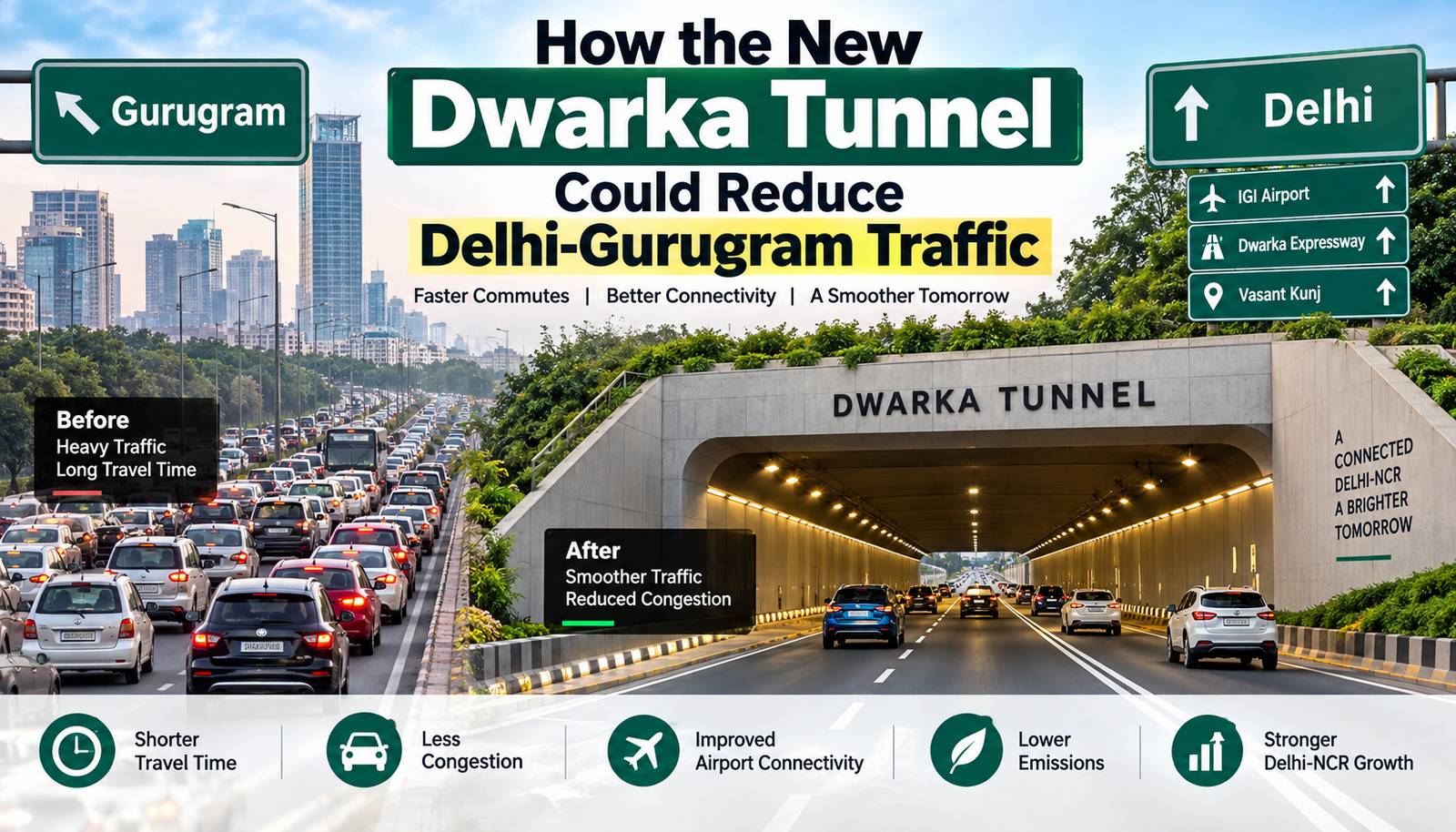
Traffic congestion has become one of the biggest challenges for people travelling between Delhi and Gurugram. Thousands of commuters use the Delhi-Gurugram corridor every day for work, business, airport travel and other purposes. As traffic volumes continue to increase, improving alternative routes has become an important part of Delhi-NCR’s infrastructure planning.
One of the major upcoming projects aimed at improving connectivity is the new six-lane Dwarka Tunnel corridor, which will connect the Dwarka Expressway at Shiv Murti Interchange with Nelson Mandela Marg in Vasant Kunj.
The Union Cabinet approved the project in July 2026. According to the Ministry of Road Transport & Highways, the project has a total length of 8.1 km and an estimated capital cost of ₹6,969.67 crore. It will include a 3.14-km twin-tube tunnel, along with elevated and at-grade sections.
The project could become an important alternative route for traffic travelling between Gurugram, Dwarka, South Delhi and IGI Airport, potentially reducing pressure on some of the existing congested corridors.
What Is the Dwarka Tunnel Project?
The Dwarka Tunnel is part of Delhi-NCR’s wider road infrastructure and decongestion strategy.
The proposed corridor will start near the Shiv Murti Interchange on the Dwarka Expressway and connect with Nelson Mandela Marg in Vasant Kunj.
The overall 8.1-km project includes:
- 3.14 km of twin-tube tunnel
- 0.98 km of tunnel approach ramps
- 2.556 km of elevated road
- 0.554 km of approach with retaining structures
- 0.87 km of at-grade road
The tunnel will pass beneath part of the Southern Ridge, with approximately 1.98 km running beneath the Ridge. The underground design is intended to minimise surface-level disruption while maintaining connectivity through the area.
This means the project is not simply a conventional road tunnel. It is a larger connectivity corridor combining underground, elevated and surface-road infrastructure.
How Could the Dwarka Tunnel Reduce Delhi-Gurugram Traffic?
The biggest potential advantage of the project is traffic redistribution.
At present, commuters travelling between Gurugram and different parts of Delhi often have to rely on routes around NH-48, Mahipalpur, IGI Airport, Rangpuri and other busy junctions.
The new corridor is designed to create a more direct connection between the Dwarka Expressway and South Delhi.
The government has specifically stated that the project is expected to benefit traffic from Gurugram, Dwarka, IGI Airport and West Delhi.
1. It Could Provide an Alternative to Existing Congested Routes
One of the main reasons traffic becomes severe in Delhi-NCR is the concentration of vehicles on a limited number of major corridors.
The Dwarka Tunnel could provide an additional high-capacity route between the Dwarka Expressway and South Delhi.
Instead of all vehicles using existing surface corridors, some traffic could shift to the new tunnel.
This could help distribute traffic more efficiently and reduce pressure on busy stretches.
2. Better Connectivity Between Gurugram and South Delhi
Gurugram has developed into a major commercial and employment centre, while South Delhi contains important residential, commercial and institutional areas.
The tunnel will connect the Dwarka Expressway corridor with Vasant Kunj, creating a more direct connection between these parts of the NCR.
For commuters travelling from Gurugram towards Vasant Kunj and other parts of South Delhi, this additional route could make journeys more convenient.
The government describes the project as a high-speed, access-controlled connection between West and South Delhi that will particularly benefit traffic coming from Gurugram.
3. Improved IGI Airport Connectivity
Another major potential benefit is improved connectivity to Indira Gandhi International Airport.
Airport traffic can contribute significantly to congestion because passengers, taxis, buses, commercial vehicles and private cars all use the surrounding road network.
The proposed tunnel will create a new connection between the Dwarka Expressway side of the NCR and the Vasant Kunj/Mahipalpur area.
This could provide another route for airport-bound traffic and help reduce dependence on heavily used surface roads.
Delhi’s infrastructure plans have increasingly focused on improving connections between the airport, Gurugram and major parts of the capital. The Dwarka Expressway itself already includes infrastructure designed to improve connectivity toward the airport.
4. Reduced Pressure on Mahipalpur and Rangpuri Routes
The existing road network around Mahipalpur, Rangpuri and the airport handles significant traffic volumes.
The new tunnel is intended to provide an alternative connection that can bypass some of these congested surface routes.
According to the government’s description of the project, the new corridor is expected to reduce dependence on routes including Dhaula Kuan–IGI Airport–Mahipalpur, Chhatarpur–Mahipalpur and Rangpuri–Mahipalpur.
This does not mean these roads will become congestion-free. Rather, the objective is to give commuters additional route choices and distribute traffic more effectively.
5. The Project Could Improve Travel Reliability
For daily commuters, traffic is not only about the average travel time. Unpredictability is also a major problem.
A journey that normally takes 30–40 minutes can take significantly longer when there is congestion, an accident, roadwork or a bottleneck.
A dedicated, access-controlled tunnel corridor could provide a more predictable alternative for eligible vehicles.
This could be particularly useful for:
- Daily office commuters
- Airport passengers
- Cab and taxi operators
- Commercial vehicles
- Business travellers
- Residents travelling between Gurugram and South Delhi
The larger Delhi decongestion strategy is focused on reducing travel delays and improving traffic flow across multiple corridors rather than depending on a single project.
How the Tunnel Connects With Dwarka Expressway
The success of the project will also depend on its connection with the existing Dwarka Expressway.
The Delhi section of Dwarka Expressway provides connectivity from the Shiv Murti area towards Dwarka and the Delhi-Haryana border. The 10.1-km Delhi section was developed as part of the government’s wider plan to improve mobility and decongest Delhi-NCR.
The proposed tunnel would effectively extend this connectivity towards Vasant Kunj and South Delhi.
This creates the possibility of a broader movement corridor:
Gurugram → Dwarka Expressway → Shiv Murti → Dwarka Tunnel → Vasant Kunj/South Delhi
Such integration is important because infrastructure projects work best when they function as part of a connected network rather than as isolated roads.
New Elevated Road Proposals Could Further Improve Traffic Flow
The tunnel project also includes additional infrastructure around its connecting roads.
The government has proposed an approximately 1.8-km elevated road along Nelson Mandela Marg, along with other improvements around the Chhatarpur–Mahipalpur intersection.
More recently, NHAI has also proposed a three-lane elevated corridor between the Dwarka Expressway tunnel area near Shiv Murti and Ambience Mall, intended to carry traffic towards Gurugram while existing NH-48 traffic continues on the main carriageway. The proposal was reported on September 10, 2026 and is still under evaluation.
If these connections are implemented effectively, they could further improve the ability of traffic to move between the tunnel, Delhi and Gurugram.
What Areas Could Benefit From the Dwarka Tunnel?
The project could have an impact across several parts of Delhi-NCR.
Gurugram
Gurugram commuters could potentially get another route towards South Delhi and the airport.
Dwarka
Residents of Dwarka and nearby areas could benefit from improved connections towards Vasant Kunj and South Delhi.
Vasant Kunj
The project would provide a direct high-capacity connection towards the Dwarka Expressway corridor.
Mahipalpur
Improved traffic distribution could help reduce pressure on some existing approaches to the area.
IGI Airport
Passengers travelling from Gurugram, Dwarka and western parts of Delhi could benefit from improved connectivity.
South Delhi
Areas connected to Nelson Mandela Marg could gain better access to the Dwarka Expressway and Gurugram side of the NCR.
Could the Dwarka Tunnel Reduce Pollution?
Traffic congestion and vehicle emissions are closely connected because vehicles spend more time idling and travelling at low speeds during severe congestion.
A better-connected road network can potentially reduce unnecessary delays and improve traffic flow.
The government’s broader decongestion strategy identifies benefits such as lower travel time, reduced vehicular emissions, improved road safety and lower logistics costs.
However, the tunnel should not be viewed as a standalone solution to Delhi’s air-pollution problem. Pollution levels depend on many factors, including total vehicle use, fuel types, weather conditions, industrial emissions and construction activity.
The larger benefit would come from improving traffic flow while encouraging efficient movement across the NCR network.
Impact on Delhi-NCR Real Estate
Large infrastructure projects can also influence real estate markets.
Improved road connectivity can make previously less-connected locations more accessible to employment hubs, airports, commercial centres and major highways.
The Dwarka Expressway has already become an important real-estate corridor connecting Delhi and Gurugram.
The proposed tunnel could further strengthen connectivity between the Dwarka Expressway, Vasant Kunj, South Delhi and the airport corridor.
This may increase interest in residential and commercial areas that gain improved accessibility.
However, property prices should not be expected to rise automatically simply because a tunnel is announced. Factors such as project completion, actual traffic benefits, local infrastructure, developer quality, supply and demand, and proximity to employment hubs will also influence property values.
Dwarka Tunnel vs Existing Delhi-Gurugram Routes
| Factor | Existing Routes | Proposed Dwarka Tunnel |
|---|---|---|
| Connectivity | Multiple congested surface routes | Direct high-capacity connection |
| Gurugram Access | Strong but congestion-prone | Additional route through Dwarka Expressway |
| South Delhi Access | Depends on existing corridors | Direct connection towards Vasant Kunj |
| Airport Connectivity | Existing airport corridors | Additional connectivity option |
| Traffic Distribution | Concentrated on major routes | Designed to distribute traffic |
| Infrastructure | Surface roads, flyovers and expressways | Twin-tube tunnel + elevated sections |
| Long-term Potential | Increasing traffic pressure | Additional network capacity |
When Will the Dwarka Tunnel Be Completed?
The project has been approved by the Union Cabinet, but it is important to distinguish project approval from project completion.
The official announcement confirms the project scope, alignment and estimated cost, but the final operational date should be based on official construction schedules and subsequent NHAI updates rather than assuming a completion date.
The project will be implemented by NHAI under the Ministry of Road Transport & Highways using the Hybrid Annuity Mode.
As construction progresses, factors such as land requirements, utility shifting, tunnel construction, safety systems, environmental considerations and integration with connecting roads can influence the timeline.
Why the Dwarka Tunnel Is Important for Delhi-NCR
Delhi-NCR cannot solve congestion simply by widening existing roads indefinitely.
The region needs a combination of:
- New expressways
- Alternative corridors
- Tunnels
- Elevated roads
- Underpasses
- Better junction design
- Public transport integration
- Intelligent traffic management
The Dwarka Tunnel fits into this broader approach.
It is particularly significant because it connects several strategically important areas: Gurugram, Dwarka, Vasant Kunj, South Delhi and IGI Airport.
It also forms part of a wider decongestion strategy that includes the Dwarka Expressway and Urban Extension Road-II.
Final Thoughts
The Dwarka Tunnel Delhi Gurugram traffic project could become an important part of Delhi-NCR’s future transportation network.
With an 8.1-km corridor, six lanes, a 3.14-km twin-tube tunnel and an estimated cost of ₹6,969.67 crore, the project is designed to create a faster connection between the Dwarka Expressway and Vasant Kunj.
Its biggest potential advantage is not simply the tunnel itself, but the additional connectivity it creates.
By giving traffic from Gurugram, Dwarka and western Delhi another route towards South Delhi and the airport, the project could help distribute traffic away from some existing bottlenecks.
The proposed elevated connections could further strengthen this network.
For commuters, the expected benefits include better connectivity, potentially more predictable journeys and improved access to key destinations. For businesses and the real-estate sector, improved connectivity could also support long-term growth around well-connected parts of Delhi-NCR.
Ultimately, the real impact will depend on how efficiently the tunnel integrates with the existing Dwarka Expressway, NH-48, airport roads and South Delhi corridors. If these links work together effectively, the project could play a meaningful role in reducing congestion between Delhi and Gurugram.