How 3 Orbital Rail Corridors Could Transform Delhi-NCR Connectivity
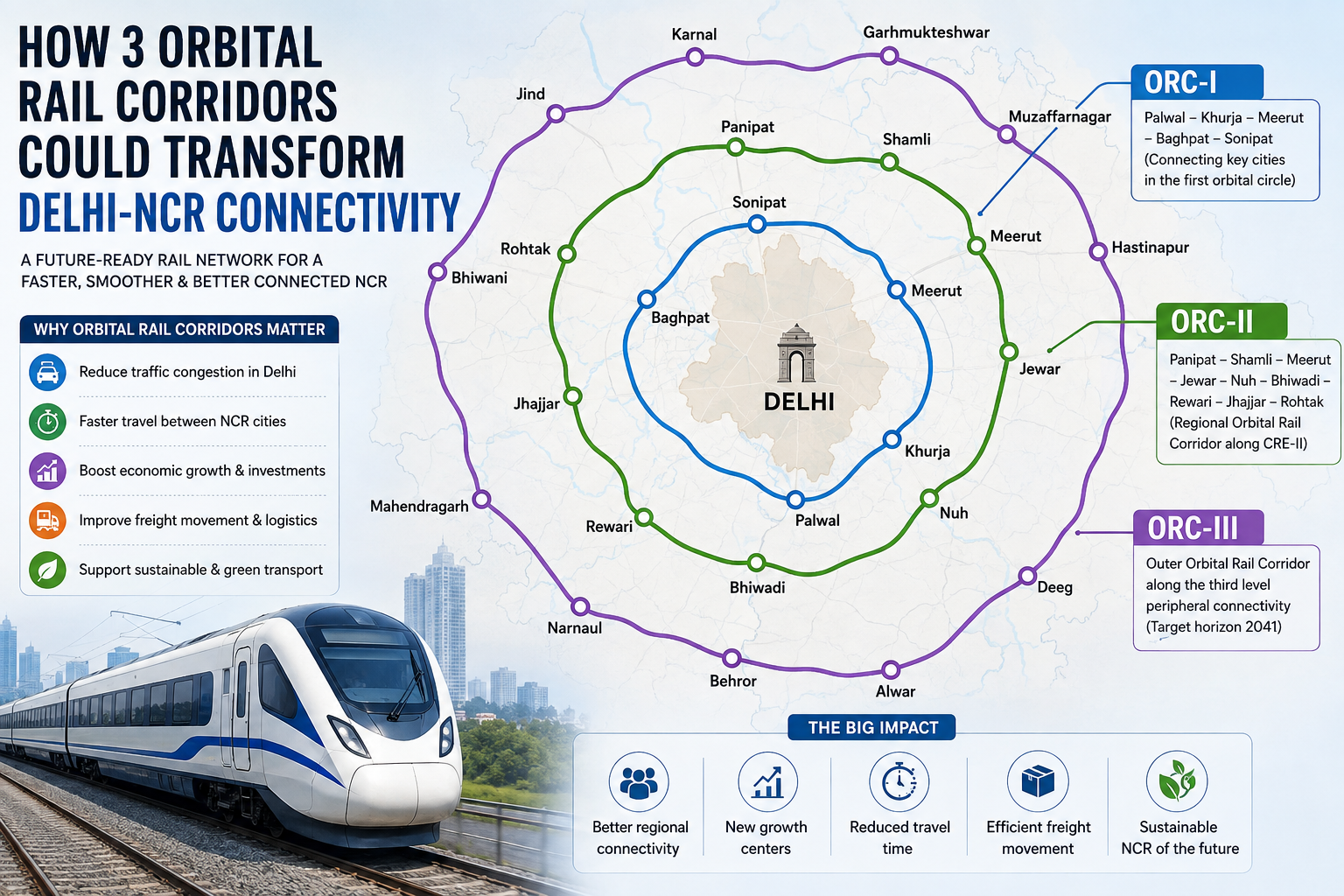
Delhi-NCR is one of India’s fastest-growing urban and economic regions, connecting Delhi with major cities and industrial centres across Haryana, Uttar Pradesh and Rajasthan. As population, employment and economic activity continue to expand, transportation infrastructure is facing increasing pressure. Roads and existing rail networks carry enormous volumes of passengers and freight every day, much of which is concentrated around Delhi.
To address this challenge, the National Capital Region Planning Board (NCRPB) has proposed a network of three Orbital Rail Corridors (ORCs) as part of its long-term regional transport vision. These corridors are designed to improve movement between different parts of NCR, support regional development and allow certain passenger and freight movements to bypass the heavily congested Delhi-Central National Capital Region area.
The proposed network could become an important part of the future transportation system of Delhi-NCR. But what exactly are these three orbital rail corridors, and how could they transform connectivity across the region?
What Are Orbital Rail Corridors?
An orbital rail corridor is essentially a railway route designed to connect different regional centres without requiring every journey to pass through the central city.
Delhi has traditionally been the focal point of transportation in NCR. Many railway and road routes operate in a radial pattern, with Delhi acting as the central hub. While this model has supported economic growth, it also contributes to congestion because passengers and freight moving between two peripheral parts of NCR may have to travel toward or through Delhi.
The concept of an orbital rail network aims to change this pattern.
According to the NCRPB’s Draft Regional Plan-2041, three Orbital Rail Corridors have been proposed based on feasibility. ORC-I would create an orbital connection involving Palwal, Khurja, Meerut, Baghpat and Sonipat; ORC-II is envisioned as a Regional Orbital Rail Corridor connecting Panipat, Shamli, Meerut, Jewar, Nuh, Bhiwadi, Rewari, Jhajjar and Rohtak; and ORC-III is proposed as an Outer Orbital Rail Corridor along the third-level peripheral connectivity system.
This means the proposed network is not simply another railway line into Delhi. Instead, its broader objective is to strengthen cross-NCR connectivity.
Understanding the 3 Proposed Orbital Rail Corridors
1. ORC-I: Creating a Wider Regional Rail Circle
The first proposed Orbital Rail Corridor is intended to connect important towns across Haryana and Uttar Pradesh and complete a larger railway circle around Delhi.
The Draft Regional Plan-2041 describes ORC-I as a connection involving Palwal, Khurja, Meerut, Baghpat and Sonipat. The plan envisages the development of this orbital connection in stages, with the objective of creating a continuous regional rail route.
The significance of ORC-I lies in the number of major regional centres it could connect. Instead of depending entirely on Delhi as a transportation hub, passengers and goods could potentially move between these peripheral locations through an orbital route.
For example, better rail connectivity between southern, eastern and northern parts of NCR could create more direct travel options and reduce pressure on routes leading toward central Delhi.
2. ORC-II: Connecting Major Growth and Industrial Centres
The second proposed corridor is particularly interesting because of the number of emerging economic centres along its alignment.
The NCRPB describes ORC-II as a Regional Orbital Rail Corridor (RORC) connecting Panipat, Shamli, Meerut, Jewar, Nuh, Bhiwadi, Rewari, Jhajjar and Rohtak, broadly following the second Comprehensive Regional Expressway (CRE-II) alignment. Its stated purpose is to facilitate fast regional passenger and goods movement while avoiding the Central National Capital Region area.
This corridor could have significant implications for industrial and commercial connectivity.
Locations such as Jewar, Nuh, Bhiwadi, Rewari and Panipat are connected to important economic activities, industrial zones, logistics networks and developing urban areas. A stronger regional railway network could make movement between these centres easier while reducing dependence on Delhi-centric routes.
For businesses, this could mean improved access to workers, suppliers, markets and logistics infrastructure.
3. ORC-III: The Outer Orbital Rail Corridor
The third proposed corridor represents a longer-term vision for an Outer Orbital Rail Corridor (OORC).
The Draft Regional Plan-2041 proposes ORC-III along the third Comprehensive Regional Expressway alignment, with a target horizon extending toward 2041. The plan also identifies potential missing links for feasibility studies, including connections around Karnal, Jind, Bhiwani, Mahendragarh, Narnaul, Behror, Alwar, Deeg, Khurja, Garhmukteshwar, Hastinapur and Muzaffarnagar.
Because this is a longer-term proposal, its final alignment, implementation strategy and feasibility would need to be established through subsequent planning and project development.
Nevertheless, the concept demonstrates a shift toward thinking about NCR as a large interconnected economic region rather than simply a collection of cities dependent on Delhi.
How 3 Orbital Rail Corridors Could Transform Delhi-NCR Connectivity
The biggest potential benefit of the proposed orbital network is its ability to create alternative routes for regional movement.
1. Reducing Pressure on Delhi-Centric Routes
One of the main purposes of an orbital railway is to allow certain regional journeys to bypass central Delhi.
The NCRPB has previously described the orbital rail concept as a way to connect radial railway corridors and enable regional traffic to bypass Delhi.
This could be particularly useful for freight and passengers travelling between peripheral NCR cities.
If a journey between two regional centres can be completed without entering central Delhi, the demand on existing Delhi railway routes and major road corridors could potentially decrease.
2. Better Connectivity Between NCR Cities
Delhi-NCR includes a large number of interconnected cities and towns. Gurgaon, Noida, Ghaziabad, Faridabad, Sonipat, Panipat, Meerut, Rewari, Rohtak, Bhiwadi and other regional centres are becoming increasingly important economic destinations.
However, connectivity between these peripheral centres is not always as direct as connectivity with Delhi.
Orbital rail corridors could address this gap by creating stronger city-to-city and region-to-region connections.
This could encourage more people to live and work outside Delhi while still benefiting from access to the wider NCR economy.
3. Supporting Passenger Mobility
The proposed orbital network is not only about freight.
The NCRPB’s regional planning framework also emphasises commuter and regional passenger connectivity. The broader NCR transport strategy includes integration between regional rail systems, metro networks and other public transport modes.
An effective orbital rail system could therefore provide additional options for people travelling between employment hubs, residential areas, educational centres and commercial destinations.
Instead of every commuter journey being Delhi-focused, mobility could become more distributed across the NCR.
4. Improving Freight Movement
Freight transportation is another important potential benefit.
Delhi is a major consumption and distribution centre, but large volumes of goods moving across NCR do not necessarily need to enter the central capital area.
Orbital rail corridors could provide alternative regional routes for goods movement, particularly when integrated with freight corridors, logistics parks, industrial areas and road networks.
The NCR’s transport planning documents have also highlighted the importance of dedicated freight infrastructure and feeder connections in supporting regional economic activity.
A better balance between road and rail freight could eventually contribute to more efficient logistics across the region.
5. Boosting Economic Development Beyond Delhi
Transportation infrastructure often influences where businesses choose to locate.
When a city or industrial area receives better connectivity, it can become more attractive for companies, logistics operators, investors and workers.
The proposed orbital corridors could therefore support the development of regional economic centres outside Delhi.
Areas such as Rewari, Bhiwadi, Nuh, Jewar, Sonipat, Panipat and other connected locations could benefit from improved regional accessibility if the planned network is implemented successfully.
NCRTC also highlights that improved regional transit can influence economic activity by reducing travel times and improving access between regional centres.
Impact on Gurgaon and the Surrounding Region
Gurgaon, now one of India’s major corporate and employment hubs, is particularly dependent on regional connectivity.
The city has strong links with Delhi, Manesar, Rewari, Bhiwadi and other parts of Haryana. The broader NCR transport network is already being expanded through regional rail initiatives.
It is important to distinguish the proposed Orbital Rail Corridors from the Namo Bharat network. NCRTC’s current Phase-1 Namo Bharat corridors include Delhi-Ghaziabad-Meerut, Delhi-Gurugram-SNB-Alwar and Delhi-Panipat-Karnal. These corridors are designed for high-speed regional passenger connectivity and are being integrated with metro, railway, airport and bus networks.
The orbital rail concept is broader. It focuses on creating routes around the NCR that can facilitate regional passenger and goods movement while reducing dependence on central Delhi.
Together, different layers of transport infrastructure could create a more connected regional mobility ecosystem.
Potential Impact on NCR Real Estate
Improved connectivity can also influence real estate development.
When a location becomes easier to access, it may become more attractive to homebuyers, businesses and investors. New transport infrastructure can encourage residential development, commercial activity and the expansion of employment hubs.
The proposed Orbital Rail Corridors could therefore create new opportunities for real estate markets across NCR, particularly in areas located near future transport nodes.
However, investors should avoid assuming that every location along a proposed alignment will automatically experience significant price appreciation. Actual impact will depend on factors such as station locations, project execution, last-mile connectivity, employment growth, land-use planning and infrastructure delivery.
For property buyers, the important factor will be the quality and usability of connectivity, rather than simply the announcement of a railway project.
Integration With Namo Bharat, Metro and Roads
The success of the future NCR transportation system will depend on integration.
A railway corridor by itself cannot solve regional mobility problems. Passengers need convenient connections between railway stations, metro systems, buses, airports, roads and residential or commercial areas.
NCRTC has already adopted a multi-modal integration approach for Namo Bharat, with stations planned to connect with Indian Railways, Delhi Metro, airports and bus terminals wherever possible.
This model could become increasingly important as NCR develops multiple layers of regional transport infrastructure.
A future commuter could potentially use:
Local transport → Metro → Namo Bharat → Orbital Rail → Bus/Road
Such integration could make long-distance regional commuting more practical and reduce dependence on private vehicles.
Environmental Benefits
Transportation growth has environmental consequences.
Greater dependence on private cars, buses and trucks can contribute to congestion, fuel consumption and emissions. A well-integrated regional railway system could encourage more people and businesses to shift some journeys from road to rail.
NCRTC describes regional rapid transit as offering environmental and economic benefits through faster and more efficient regional mobility.
However, the environmental impact of orbital rail will depend on factors such as ridership, electrification, station accessibility and integration with other sustainable transport modes.
Challenges Ahead
Despite the potential benefits, developing three large orbital rail corridors would be a complex undertaking.
Land acquisition, project financing, inter-state coordination, environmental considerations, engineering feasibility and integration with existing railway infrastructure will all be important.
The proposed ORC-III, in particular, has a long-term horizon and includes potential missing links that require feasibility studies.
Another challenge will be ensuring that stations are located where they can actually serve communities and economic centres. Railway connectivity is most valuable when stations have strong last-mile connections.
Therefore, the success of the orbital network will depend not only on laying tracks but also on creating a complete transportation ecosystem around them.
What Could Delhi-NCR Look Like in the Future?
If the proposed orbital rail network is implemented alongside Namo Bharat, Delhi Metro expansion, peripheral expressways and freight infrastructure, Delhi-NCR could gradually move toward a more polycentric transportation model.
Instead of Delhi functioning as the unavoidable centre of most regional journeys, multiple economic and transport hubs could develop around the region.
Gurgaon, Noida, Ghaziabad, Meerut, Sonipat, Rewari, Bhiwadi, Panipat, Rohtak, Jewar and other centres could become increasingly interconnected.
This could support a more balanced distribution of jobs, housing, businesses and economic activity across NCR.
Conclusion
The question of how 3 Orbital Rail Corridors could transform Delhi-NCR connectivity is ultimately about more than railway infrastructure.
ORC-I, ORC-II and ORC-III represent a long-term vision for creating stronger regional connections around Delhi. The proposed corridors could help bypass congested areas, improve passenger and freight movement, connect emerging economic centres and support more balanced regional development.
The NCRPB’s Draft Regional Plan-2041 places these th