Haryana’s NCR Road Revamp: How Better Roads Could Transform Gurgaon’s Connectivity
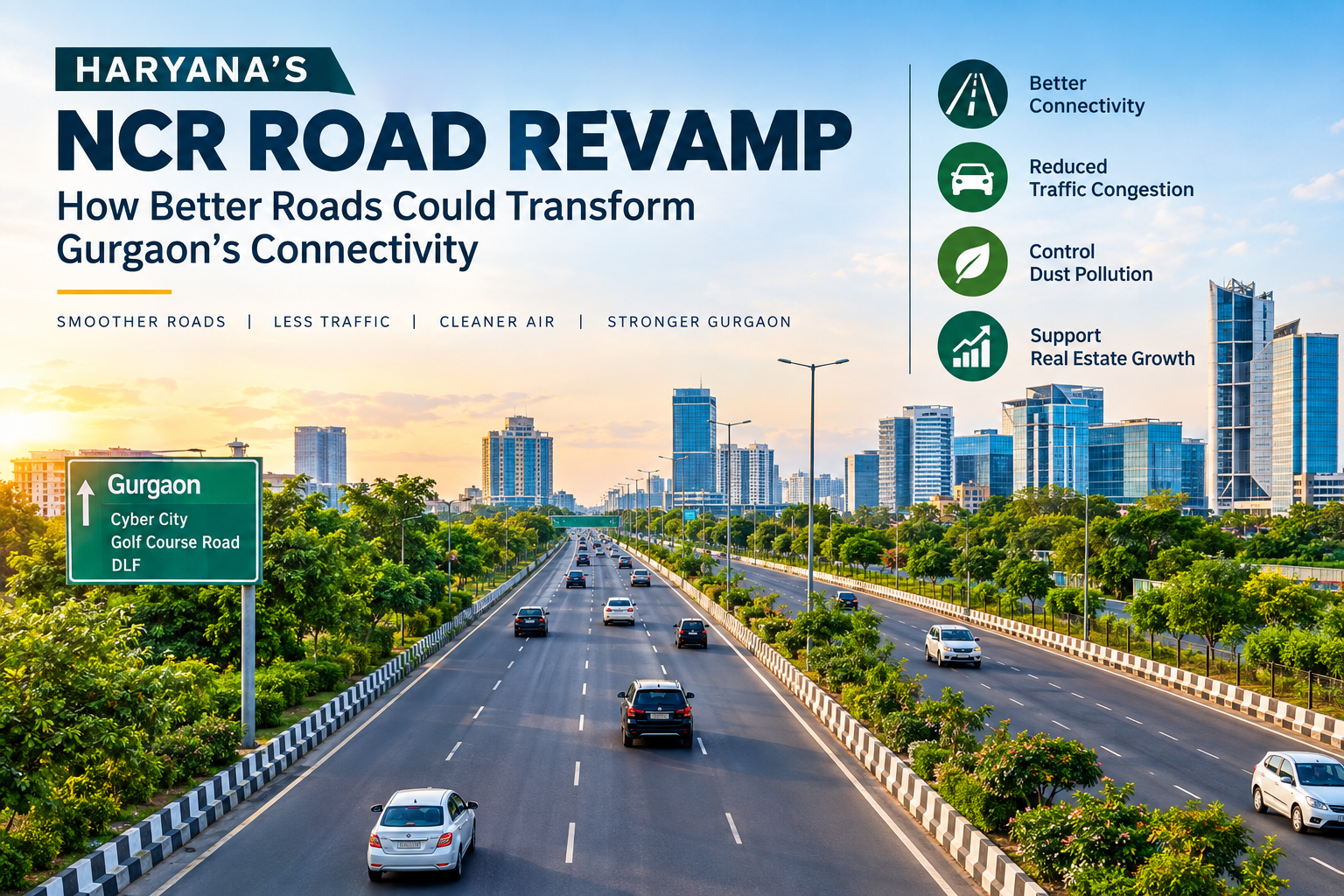
Haryana’s growing focus on road infrastructure and urban connectivity is bringing renewed attention to Gurgaon’s transportation network. As one of India’s major corporate and residential destinations, Gurgaon depends heavily on efficient roads to connect residential sectors, business districts, industrial areas, and neighbouring cities across the National Capital Region (NCR).
The Haryana NCR Road Revamp initiative represents an important development for residents, commuters, businesses, and real estate stakeholders looking at the future of Gurgaon’s urban development. Better-maintained roads, improved junctions, effective drainage, and dust-control measures can contribute to smoother commuting and more organised urban growth.
With increasing residential development and commercial activity across Gurgaon, road infrastructure has become an important consideration for homebuyers and property investors. Areas with convenient access to employment centres, highways, and public transportation can offer practical advantages for people choosing where to live.
In this blog, we explore how Haryana’s road infrastructure development could influence Gurgaon’s connectivity, traffic conditions, environmental quality, and real estate landscape.
1. Understanding the Haryana NCR Road Revamp Initiative
The Haryana NCR Road Revamp is part of a broader effort to improve urban road infrastructure, address road dust pollution, and strengthen mobility across Haryana’s National Capital Region.
On June 8, 2026, CSIR-Central Road Research Institute (CSIR-CRRI) signed an agreement with the Haryana government to implement a standard framework for paving and greening urban roads. The programme involves CSIR-CRRI, the School of Planning and Architecture (SPA), and the Commission for Air Quality Management (CAQM).
Press Information Bureau
The initiative focuses on scientific road engineering rather than only repairing damaged road surfaces. Its key components include:
- Developing appropriate road designs and cross-sections.
- Paving and greening road corridors to control dust.
- Introducing improved road maintenance practices.
- Using innovative technologies for road construction and maintenance.
The framework is intended to support sustainable urban road infrastructure across Haryana’s NCR cities, including Gurugram, Faridabad, Manesar, Sonipat, and other urban centres.
For Gurgaon, this approach is relevant because the city has experienced rapid urbanisation, increasing vehicle movement, and expanding residential neighbourhoods. A coordinated infrastructure strategy could help address road conditions and connectivity challenges across different sectors.
It is important to note that the programme involves planning, implementation, and redevelopment at different stages. The actual benefits for individual roads will depend on project execution, funding, maintenance, and coordination between the responsible agencies.
2. Why Gurgaon Needs Better Road Connectivity
Gurgaon has developed into a major employment and residential hub, attracting professionals, businesses, entrepreneurs, and homebuyers from different parts of India.
However, rapid development has also increased pressure on the city’s transportation network. Many residential sectors have expanded alongside commercial projects, creating additional demand for road access and efficient traffic movement.
Some of the key connectivity challenges include:
Increasing traffic congestion
Major roads connecting residential sectors with corporate offices experience significant traffic during peak commuting hours. Employees travelling towards Cyber City, Udyog Vihar, Golf Course Road, and other business districts depend on these corridors for daily movement.
Traffic bottlenecks at busy junctions can increase travel times and create difficulties for both private and commercial vehicles.
Uneven road conditions
Road quality can vary considerably between established neighbourhoods and developing sectors. Potholes, damaged surfaces, incomplete road sections, and utility-related excavations can interrupt traffic and create additional maintenance requirements.
Rapid expansion of residential areas
New Gurgaon and the southern sectors have experienced substantial residential and commercial development. As more people move into these locations, demand for connected roads, public transport, pedestrian facilities, and supporting infrastructure increases.
The Haryana NCR Road Revamp could help address some of these issues through planned road improvements, better engineering standards, and more systematic maintenance.
However, road redevelopment alone cannot resolve every traffic problem. Effective public transport, traffic management, enforcement, and coordinated urban planning will also remain important.
3. How Better Roads Could Improve Gurgaon’s Connectivity


6
Road connectivity plays a central role in how people travel between residential areas, workplaces, educational institutions, hospitals, and commercial centres.
The proposed infrastructure improvements could support Gurgaon in several ways.
Better connections between residential and commercial areas
Gurgaon’s development is spread across multiple corridors. Residents in developing sectors often travel considerable distances to reach established employment centres and business districts.
Improved internal roads and better-connected arterial routes could provide more convenient access between residential neighbourhoods and major employment locations.
For example, residents in southern Gurgaon may benefit from better-maintained connections to the Southern Peripheral Road (SPR), Golf Course Extension Road, and other major corridors, subject to the specific roads selected for improvement.
This could make everyday travel more predictable and improve access to essential services.
Improved access to highways and neighbouring cities
Gurgaon serves as an important link between Delhi, Manesar, Faridabad, and other NCR destinations.
The city relies on major transportation corridors, including NH-48 and the Delhi-Gurgaon Expressway, for passenger and commercial movement.
Road upgrades and improved junction designs could help vehicles move more efficiently between local roads and major highways.
Better integration between arterial roads, sector roads, and highway access points could also support commercial transportation and logistics activities.
More convenient daily commuting
For working professionals, the quality of road connectivity directly affects daily routines.
Well-maintained roads, clearly marked lanes, safe junctions, and organised pedestrian crossings can make commuting more comfortable and predictable.
The impact would depend on the scale and location of individual projects, but coordinated improvements across connected road networks could help reduce avoidable delays.
4. Road Dust Control: An Important Part of Gurgaon’s Infrastructure Development


7
One of the central objectives of Haryana’s urban road programme is to address road dust pollution.
Road dust can originate from damaged surfaces, exposed soil, unpaved shoulders, construction activities, and the movement of vehicles over accumulated dust.
The issue becomes particularly visible during dry periods, when loose particles can be lifted into the air by passing traffic.
In August 2026, reporting by The Times of India identified Golf Course Extension Road, Old Delhi Road, and Udyog Vihar among Gurgaon stretches experiencing recurring dust problems during dry weather.
The Times of India
Paving road shoulders and exposed areas
Unpaved shoulders and loose soil along roads can become recurring sources of dust.
Paving suitable roadside areas and ensuring that road construction is properly completed could reduce the amount of loose material available to be carried into the air.
This is especially relevant in developing sectors where construction activity and incomplete roadside infrastructure can contribute to dust accumulation.
Introducing roadside greenery
Roadside planting and green spaces can contribute to more organised urban corridors.
The Haryana framework specifically includes greening measures within road rights-of-way.
Press Information Bureau
Properly designed green areas can complement paved footpaths, drainage systems, and road shoulders.
However, greenery needs appropriate planning, irrigation, and maintenance. Planting alone cannot eliminate road dust or substitute for proper paving and cleaning.
Regular road cleaning and maintenance
Mechanical sweeping, removal of accumulated silt, and appropriate dust suppression measures are important for keeping roads in usable condition.
Haryana’s January 2026 Gurugram district review also addressed road repair complaints, mechanical sweeping, removal of construction and demolition waste, and water sprinkling on critical road stretches.
PRMS
The long-term effectiveness of these measures will depend on consistent implementation rather than temporary action during periods of high pollution.
5. How Road Improvements Could Influence Gurgaon’s Real Estate Market


6
Road infrastructure is an important factor in residential real estate because it influences how easily people can access workplaces, schools, healthcare facilities, shopping centres, and public transportation.
As the Haryana NCR Road Revamp progresses, improved connectivity could influence residential preferences across different parts of Gurgaon.
Better accessibility for residential sectors
Homebuyers often consider commuting time and access to major roads when evaluating a property.
Residential projects with convenient access to employment hubs and major transportation corridors may appeal to professionals who want to reduce daily travel difficulties.
Improved road connectivity in developing areas could also make neighbourhoods more accessible to people working in established business districts.
However, improved connectivity does not guarantee property appreciation. Property prices also depend on demand, project quality, supply, financing conditions, amenities, and broader market trends.
Greater interest in emerging residential corridors
Areas such as New Gurgaon, Dwarka Expressway, and the Southern Peripheral Road corridor are relevant to discussions about Gurgaon’s expanding residential landscape.
Infrastructure improvements in and around these locations could influence how buyers compare residential options.
For example, a buyer evaluating a home in New Gurgaon may consider access to NH-48, employment centres, educational institutions, and existing civic infrastructure.
Better road access can be one consideration in that decision, alongside construction quality, legal approvals, pricing, and available amenities.
Potential benefits for commercial real estate
Commercial properties also depend on road connectivity.
Business districts require convenient access for employees, customers, suppliers, and service providers. Improved roads and organised junctions could support movement around office complexes, industrial areas, and retail destinations.
For businesses considering locations in Gurgaon, connectivity is therefore an important component of site selection and operational planning.
The extent to which road projects influence commercial demand will depend on the locations covered and the completion of supporting infrastructure.
6. Key Gurgaon Road Corridors to Watch
Different road corridors serve different transportation needs. Understanding their roles can help residents and homebuyers follow infrastructure developments relevant to their neighbourhoods.
| Road corridor | Connectivity relevance |
|---|---|
| NH-48 and Delhi-Gurgaon Expressway | Connect Gurgaon with Delhi, Manesar, and major regional transport routes. |
| Southern Peripheral Road (SPR) | Provides access between southern and western residential and commercial sectors. |
| Golf Course Extension Road | Serves residential communities, commercial developments, and business destinations in southern Gurgaon. |
| Dwarka Expressway | Supports regional connectivity between Gurgaon and Dwarka, with connections towards Delhi. |
| Old Delhi Road | Serves established neighbourhoods, industrial areas, and commercial destinations. |
These corridors are not all confirmed as part of a single redevelopment package. The actual roads covered by specific projects must be verified through announcements by GMDA, the Municipal Corporation of Gurugram, Haryana PWD, or other responsible agencies.
The IFFCO Chowk-SPR corridor
An important development for Gurgaon’s road network was reported on August 19, 2026, when a ₹41.86-crore upgrade project for the IFFCO Chowk-Southern Peripheral Road corridor received approval. The project was reported as targeting traffic bottlenecks along a major link between central Gurgaon and the southern development areas.
Delhi News – The Indian Express
The corridor’s role illustrates why junction improvements and better connections between existing roads can be important alongside the construction of new roads.
For commuters and residents, the practical impact will depend on implementation, traffic management, and the final scope of the approved work.
7. The Role of Smart Road Planning and Technology
Modern road development involves more than widening roads or repairing potholes. Cities increasingly require infrastructure systems that can monitor road conditions, identify maintenance requirements, and coordinate repairs.
Haryana’s agreement with CSIR-CRRI includes the use of a Road Asset Management System (RAMS) to improve road maintenance practices.
Press Information Bureau
Such systems can help authorities maintain information about road assets and plan maintenance more systematically.
Preventive road maintenance
Preventive maintenance involves addressing road deterioration before it develops into more extensive damage.
Regular inspections, timely repairs, and better documentation of road conditions can help authorities identify problems earlier.
For Gurgaon, this approach could be relevant to internal sector roads, arterial routes, and heavily used urban corridors.
Better drainage and monsoon preparedness
Road drainage is another important component of road infrastructure.
Poor drainage can result in waterlogging, surface damage, and difficulties for commuters during heavy rainfall.
Integrating drainage planning with road construction could help improve road durability and usability.
However, drainage improvements need coordination with stormwater networks, utility agencies, and local development plans.
Safer pedestrian infrastructure
Urban roads also serve pedestrians, cyclists, and public transport users.
Footpaths, safe crossings, accessible intersections, and appropriate street lighting can improve how people move through residential and commercial areas.
Road planning that considers these users alongside motor vehicles could contribute to more accessible urban neighbourhoods.
8. Challenges That Could Affect the Haryana NCR Road Revamp
Although infrastructure improvements can create opportunities, their actual impact depends on planning, funding, execution, and long-term maintenance.
Several challenges require attention.
Coordination between agencies: Gurgaon roads fall under different authorities, including GMDA, MCG, HSVP, Haryana PWD, and NHAI. Coordination is necessary to prevent delays and ensure that adjoining road sections are developed consistently.
Construction-related disruption: Road redevelopment may temporarily create diversions, narrowed carriageways, and additional traffic congestion. Clear traffic management plans and public communication are important during construction.
Utility management: Water pipelines, sewer lines, electricity infrastructure, and telecommunications networks often run beneath urban roads. Coordinating utility work with road construction can reduce repeated excavation.
Maintenance after completion: Even newly developed roads require regular inspection, cleaning, drainage maintenance, and timely repairs. Without these measures, road conditions can deteriorate over time.
Funding and implementation timelines: Announced projects, approved budgets, tenders, and completed construction represent different stages of development. Residents should check official project updates before assuming that a proposed improvement is operational.
Addressing these challenges will be important for translating infrastructure plans into practical improvements for everyday commuters.
9. What Gurgaon Residents and Homebuyers Should Know
For residents, road redevelopment can influence daily travel, access to local services, and the overall usability of neighbourhood infrastructure.
For homebuyers, it can be useful to evaluate road connectivity alongside other property-related considerations.
Before purchasing a property, buyers can examine:
- The distance and actual travel time to major employment centres.
- Access to highways, metro stations, and public transportation.
- The condition of approach roads and internal sector roads.
- The status of proposed infrastructure projects and their official approvals.
- The availability of drainage, pedestrian infrastructure, and essential civic services.
It is also important to distinguish between existing connectivity and proposed improvements. A project that has been announced may take time to complete, and its final design or implementation schedule can change.
Checking official government announcements and visiting the neighbourhood can provide a clearer picture of the current situation.
For real estate businesses, publishing accurate and updated information about infrastructure developments can also help prospective buyers understand the location and its accessibility.
10. The Future of Gurgaon’s Connectivity Under the Haryana NCR Road Revamp
Gurgaon’s future development will depend on how effectively transportation infrastructure keeps pace with urban expansion.
The Haryana NCR Road Revamp provides a framework for discussing road quality, dust mitigation, green infrastructure, and systematic maintenance across the region.
If implemented effectively, these measures could contribute to better road conditions, more organised urban corridors, and improved accessibility for residents and businesses.
The potential benefits extend beyond individual roads. Better coordination between internal roads, arterial routes, highways, public transportation, and pedestrian infrastructure could support a more connected urban environment.
At the same time, sustained improvements will require long-term planning, regular maintenance, effective traffic management, and coordination between the authorities responsible for different infrastructure networks.
For Gurgaon, the key consideration is not simply how many kilometres of roads are redeveloped, but whether those improvements translate into safer, cleaner, and more convenient journeys for the people who use them every day.
Frequently Asked Questions (FAQs)
1. What is the Haryana NCR Road Revamp?
The Haryana NCR Road Revamp refers to road improvement and sustainable infrastructure initiatives across Haryana’s NCR cities. These efforts include road redesign, paving, greening, dust mitigation, and improved maintenance practices.
2. How could the Haryana NCR Road Revamp benefit Gurgaon?
The initiative could support better road conditions, improved access between residential and commercial areas, reduced road dust, and more systematic maintenance. Actual benefits will depend on the projects implemented and their locations.
3. Which Gurgaon areas could benefit from better road connectivity?
Residential and commercial areas connected to major corridors such as NH-48, SPR, Golf Course Extension Road, and Dwarka Expressway may be relevant to future connectivity improvements. Benefits depend on the specific road projects undertaken.
4. Will road development increase property prices in Gurgaon?
Improved connectivity can influence property demand, but it does not guarantee price appreciation. Property values also depend on location, demand, supply, construction quality, project approvals, and broader economic conditions.
5. How does road redevelopment help reduce dust pollution?
Proper paving, sealed road shoulders, regular mechanical sweeping, roadside greening, and effective construction practices can help reduce loose dust. Consistent cleaning and maintenance are necessary for sustained results.
6. Where can residents check updates on Gurgaon road projects?
Residents can follow official updates from GMDA, MCG, Haryana PWD, the Haryana government, and the relevant highway authorities for project approvals, tenders, completion announcements, and road closures.
Conclusion
The Haryana NCR Road Revamp represents an important part of the discussion around Gurgaon’s infrastructure and urban growth. By focusing on better road engineering, dust control, maintenance, and connectivity, the initiative could help address some of the challenges associated with the city’s rapid expansion.
For commuters, these improvements could mean more convenient journeys and better access to essential destinations. For homebuyers and real estate stakeholders, connectivity will remain a significant factor when evaluating residential and commercial locations.
As Haryana’s road infrastructure projects move through planning and implementation, their long-term value will depend on execution, coordination, and consistent maintenance.