Circle Rate in Gurgaon: Sector-Wise CRC Rates, Property Prices & Market Trends
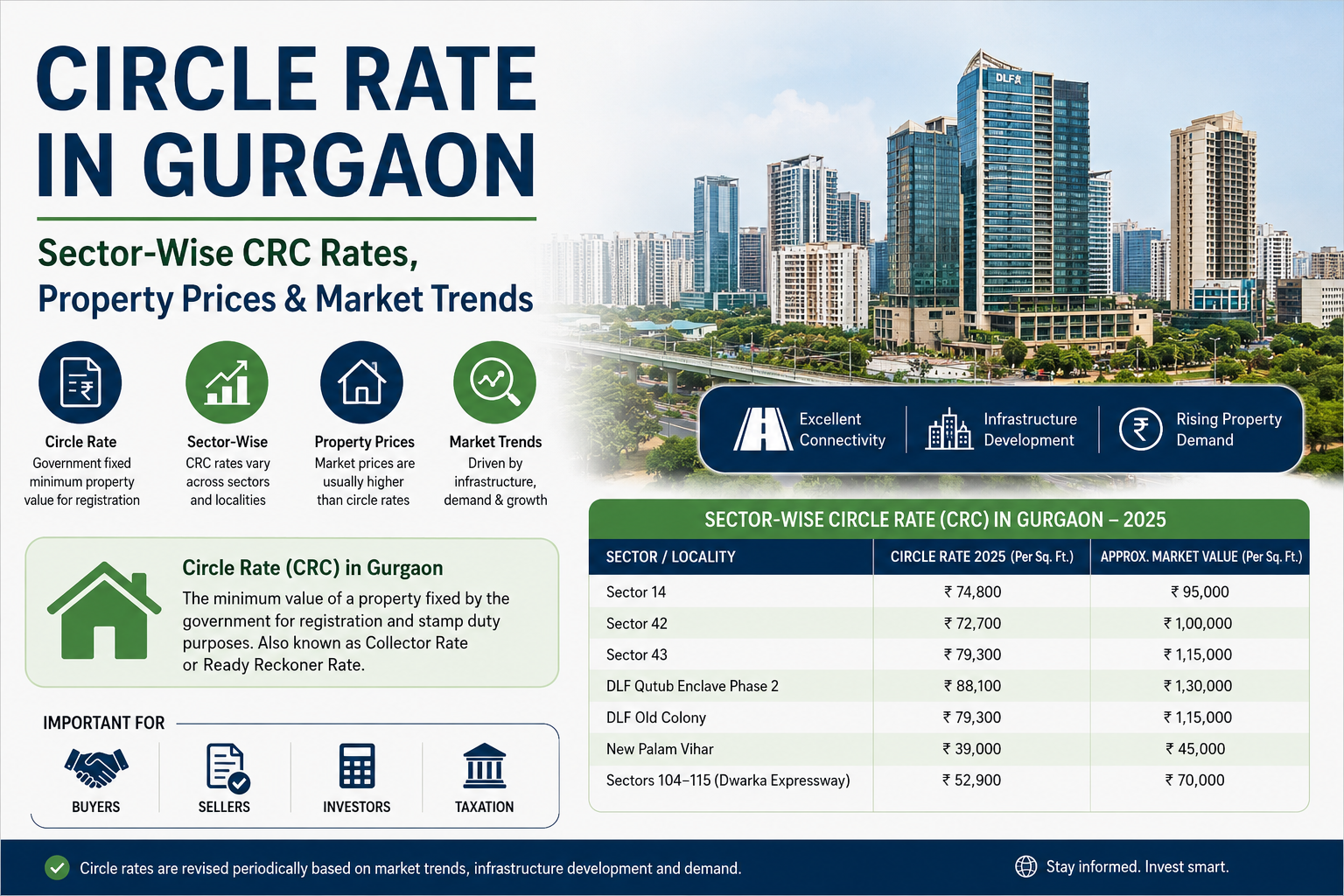
The minimum value fixed by the government for property registration in Gurgaon is known as the circle rate. A property cannot be legally registered below this benchmark value. The primary objective behind introducing circle rates is to maintain transparency in property transactions and reduce the chances of undervaluation during buying and selling.
In Gurgaon, circle rates are also referred to as CRC (Collector Rate Gurgaon). These rates are determined by the district administration and are revised periodically based on factors such as infrastructure growth, market demand, and real estate trends. Since every sector and locality has different levels of development and demand, the circle rate varies across Gurgaon depending on property type, location, and surrounding infrastructure.
This guide covers everything you need to know about Gurgaon circle rates, including sector-wise CRC rates, market value trends, calculation methods, and recent updates affecting the city’s real estate market.
Table of Contents
- What is Circle Rate in Gurgaon?
- Latest Sector-Wise Circle Rate in Gurgaon
- Premium & Affordable Sectors in Gurgaon
- Old Gurgaon vs New Gurgaon Circle Rates
- How Gurgaon Circle Rate is Calculated
- Circle Rate vs Market Rate in Gurgaon
- Impact of Circle Rate on Stamp Duty
- Factors Affecting Gurgaon Circle Rates
- How to Check Gurgaon Circle Rates Online
- Recent Updates in Gurgaon Circle Rates
- Conclusion
What is Circle Rate in Gurgaon?
The circle rate in Gurgaon is the minimum property valuation set by the government for property registration. It is also commonly known as the collector rate or ready reckoner rate. This benchmark ensures that real estate transactions are not registered below a fixed value, helping maintain fairness and transparency in the property market.
The district administration reviews and updates these rates regularly based on changing infrastructure, real estate demand, and market performance. Circle rates are important because stamp duty and registration charges are calculated on these values.
Different property categories such as residential plots, apartments, commercial properties, and agricultural land have separate circle rates. Commercial spaces generally carry higher rates because of their income-generating potential.
Latest Sector-Wise Circle Rate in Gurgaon
The circle rate differs across various sectors and localities in Gurgaon. Established residential sectors and premium corridors generally have higher rates compared to newly developing regions.
| Sector / Locality | Circle Rate 2025 (Per Sq. Ft.) |
|---|---|
| Sector 1 | ₹52,900 |
| Sector 2 | ₹55,300 |
| Sector 14 | ₹74,800 |
| Sector 15 | ₹74,800 |
| Sector 28 | ₹71,600 |
| Sector 38 | ₹64,900 |
| Sector 42 | ₹72,700 |
| Sector 43 | ₹79,300 |
| DLF Old Colony | ₹79,300 |
| DLF Qutub Enclave Phase 2 | ₹88,100 |
| Palam Vihar | ₹64,000 |
| New Palam Vihar | ₹39,000 |
| Dwarka Expressway Sectors (104–115) | ₹52,900 |
Note: Actual market prices in Gurgaon are usually higher than government circle rates.
Premium Corridors in Gurgaon
Some locations in Gurgaon command significantly higher property valuations due to their infrastructure, connectivity, and premium residential developments.
These include:
- Golf Course Road
- Golf Course Extension Road
- DLF Phases
- Sushant Lok
- MG Road vicinity
These areas offer luxury residential projects, better social infrastructure, proximity to business hubs, and excellent connectivity, which results in higher collector rates.
Affordable vs Premium Sectors
Gurgaon’s real estate market is divided between established premium sectors and rapidly developing affordable regions.
Premium Sectors
Areas such as Sector 14, Sector 42, Sector 43, and DLF phases are among the most sought-after locations due to their developed infrastructure and proximity to commercial hubs.
Affordable & Emerging Sectors
Newer sectors near Dwarka Expressway, Sohna Road, and New Gurgaon continue to attract investors because of relatively lower circle rates and future growth potential.
Old Gurgaon vs New Gurgaon Rates
The difference between Old Gurgaon and New Gurgaon plays a major role in determining sector-wise circle rates.
Old Gurgaon
Established sectors near:
- MG Road
- IFFCO Chowk
- Golf Course Road
These areas have higher benchmark values due to mature infrastructure and strong residential demand.
New Gurgaon
Locations around:
- Dwarka Expressway
- Sohna Road
- Southern Peripheral Road (SPR)
These sectors are witnessing rapid development, but their circle rates remain comparatively lower than central Gurgaon.
How is Gurgaon Circle Rate Calculated?
Several factors are considered while determining the circle rate in Gurgaon.
Location
Prime sectors and business districts usually have higher government valuations.
Infrastructure Development
Areas with better roads, metro connectivity, schools, hospitals, and civic amenities attract higher rates.
Property Type
Circle rates differ for:
- Residential plots
- Apartments
- Commercial spaces
- Agricultural land
Market Trends
Authorities also study transaction values and market demand before revising collector rates.
Circle Rate vs Market Rate in Gurgaon
Both buyers and sellers should understand the difference between circle rates and actual market prices.
| Factor | Circle Rate | Market Rate |
|---|---|---|
| Meaning | Government minimum value | Actual selling price |
| Determined By | Government authorities | Market demand |
| Purpose | Stamp duty calculation | Property transaction |
| Variation | Usually lower | Often higher |
In prime locations, the actual market value is generally much higher than the official circle rate.
Impact of Circle Rate on Stamp Duty in Gurgaon
Circle rates directly affect stamp duty and registration charges because taxes are calculated on whichever value is higher:
- Actual transaction price
- Government circle rate
Effect on Buyers
If the market value is lower than the circle rate, buyers still have to pay stamp duty according to the government valuation.
Effect on Sellers
Property registration cannot happen below the official collector rate, which can sometimes affect pricing flexibility.
Reduction of Black Money
Circle rates help reduce undervalued transactions and promote transparency in real estate dealings.
Factors Affecting Gurgaon Circle Rates
Infrastructure Growth
New roads, highways, flyovers, and civic developments increase property demand and influence circle rate revisions.
Metro Connectivity
Properties near metro stations usually experience higher appreciation and government valuations.
Commercial Development
Office hubs, IT parks, malls, and business centers increase real estate demand in surrounding sectors.
Residential Demand
Growing demand for housing in specific localities often leads to higher CRC revisions.
Urban Expansion
Areas such as New Gurgaon and Dwarka Expressway are witnessing rapid growth, leading to continuous revisions in circle rates.
How to Check Gurgaon Circle Rates Online?
You can check official Gurgaon circle rates through the district administration portal.
Steps:
- Visit the official Gurugram district website.
- Open the “Department” section.
- Select “Revenue”.
- Click on “Collector Rate”.
- Download the relevant PDF for your locality or sector.
Recent Updates in Gurgaon Circle Rates
In recent years, Gurgaon has witnessed multiple revisions in circle rates due to infrastructure expansion and increasing real estate demand.
Areas near:
- Dwarka Expressway
- Southern Peripheral Road
- New Gurgaon
have recorded significant increases because of rapid residential and commercial development.
Authorities revised circle rates in 2025 by nearly 10–20% across several sectors to bring official values closer to actual market prices.
Conclusion
The circle rate in Gurgaon plays an important role in maintaining transparency and fair valuation in the real estate market. Since these government-approved rates act as the minimum benchmark for property registration, they directly influence stamp duty, taxation, and property transactions.
Premium sectors such as Sector 14, Sector 42, Sector 43, and DLF localities continue to hold higher circle rates due to better infrastructure and strong demand. Meanwhile, developing areas along Dwarka Expressway and New Gurgaon present growth opportunities with comparatively lower benchmark values.
Before buying or selling any property, checking the latest sector-wise CRC Gurgaon rates is essential for accurate registration, tax calculation, and investment planning.
Frequently Asked Questions
Circle rate in Gurgaon is the minimum property value fixed by the government for property registration. It plays an important role in calculating stamp duty, registration charges, and legal property valuation.
When circle rates increase, the overall cost of property transactions also rises because buyers need to pay higher registration and stamp duty charges. Recent revisions in Gurugram have significantly impacted property prices across many sectors.
Premium locations such as Golf Course Road, Dwarka Expressway, DLF phases, and Southern Peripheral Road have witnessed notable increases in circle rates due to growing infrastructure and demand.
You can check the latest collector and circle rates on the official Gurugram administration website or through trusted real estate portals that publish updated sector-wise property valuation data.
Yes, purchasing property before an increase in circle rates can help buyers save on stamp duty and registration costs. Many investors monitor upcoming revisions to make cost-effective real estate decisions.