Gurugram–Faridabad–Noida RRTS: Route, Stations & Latest Updates
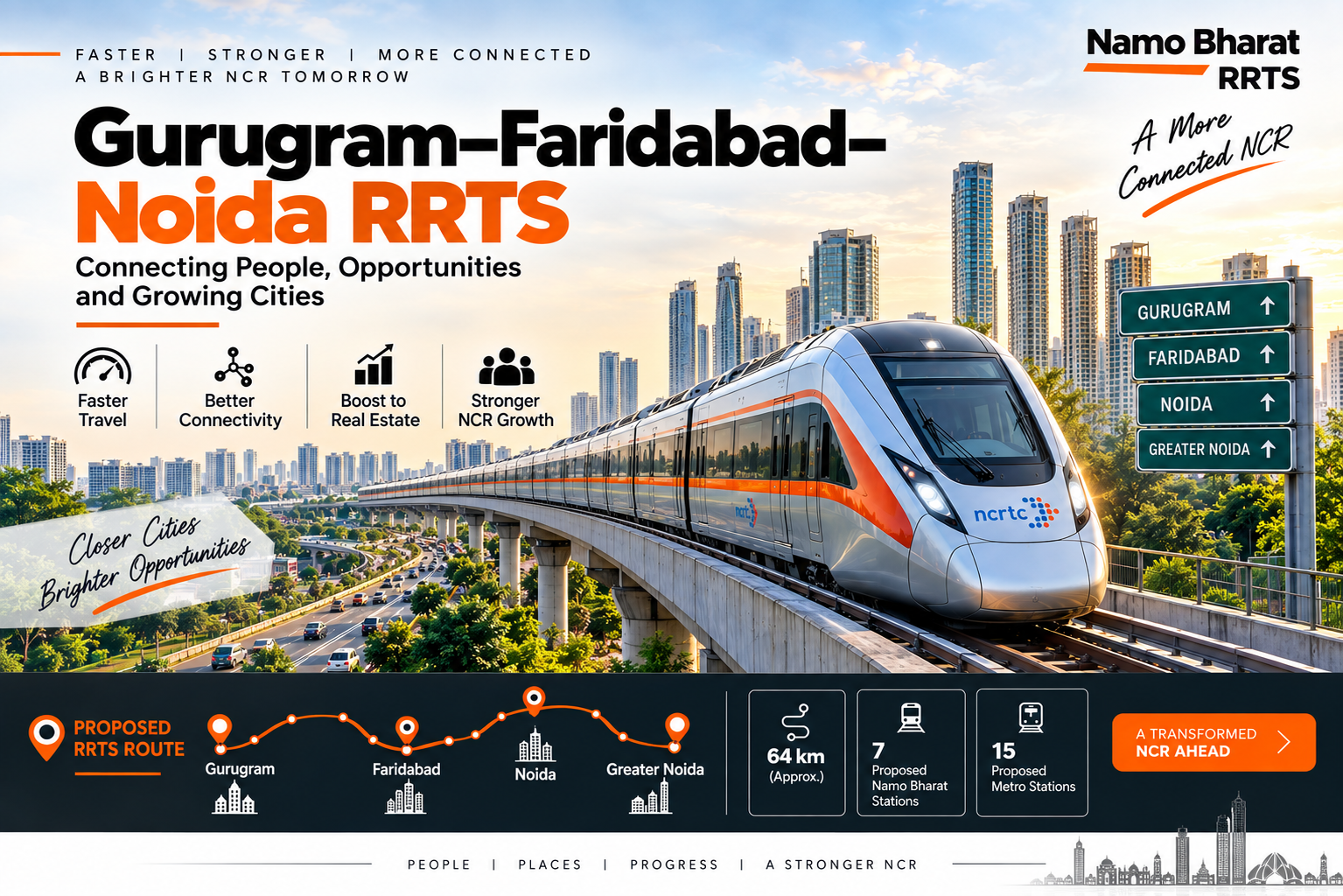
The Gurugram–Faridabad–Noida RRTS corridor is one of the proposed regional rapid transit projects that could strengthen connectivity between some of the most important urban and economic centres of the Delhi-NCR region. The proposed Namo Bharat corridor is planned to directly connect Gurugram, Faridabad, Noida and Greater Noida, creating a faster regional transport link between Haryana and Uttar Pradesh.
According to the National Capital Region Transport Corporation (NCRTC), the proposed corridor is approximately 64 km long and is planned with 7 Namo Bharat stations and 15 Metro stations at important urban and economic nodes. NCRTC currently lists the corridor among the projects in the advanced stages of approval, while the detailed route and station information remains tentative and subject to final approval.
For residents, commuters, businesses and real estate investors, the proposed corridor is important because better regional connectivity can make cross-city travel more convenient and improve access to employment centres, commercial districts and residential areas.
What Is the Gurugram–Faridabad–Noida RRTS?
The Gurugram–Faridabad–Noida RRTS is a proposed Namo Bharat regional rapid transit corridor designed to connect four major NCR cities:
- Gurugram
- Faridabad
- Noida
- Greater Noida
Unlike a conventional Metro system, Namo Bharat is designed for regional journeys, connecting major urban centres with relatively fewer stops and higher speeds.
NCRTC describes Namo Bharat as a dedicated regional transit service intended to connect important regional nodes across NCR. The system is designed for high-frequency, high-capacity and faster regional travel.
The proposed Gurugram–Faridabad–Noida corridor would therefore play a different role from local Metro networks. Instead of primarily serving short intra-city journeys, the RRTS would provide a regional connection between major employment, residential and economic hubs.
Gurugram–Faridabad–Noida RRTS Route
The proposed Gurugram–Faridabad–Noida RRTS route is planned to connect Gurugram in Haryana with Faridabad and then continue towards Noida and Greater Noida in Uttar Pradesh.
The official NCRTC project details currently describe the corridor as:
- Approximate length: 64 km
- Namo Bharat stations: 7 proposed
- Metro stations: 15 proposed
- Cities connected: Gurugram, Faridabad, Noida and Greater Noida
- Transit system: Namo Bharat RRTS with proposed Metro integration
NCRTC has stated that integration with Metro services has been proposed in both Gurugram and Faridabad, with the systems planned to operate on the same infrastructure.
However, homebuyers and investors should note that the route, station locations and other project details can change as the project moves through the approval and planning process.
Proposed Gurugram–Faridabad–Noida RRTS Stations
One of the most searched aspects of the project is the list of proposed RRTS stations.
At present, NCRTC officially states that the corridor is proposed to have 7 Namo Bharat stations and 15 Metro stations. The stations are expected to be positioned around important urban and economic nodes to serve regional passenger demand.
A final station-by-station list should be treated carefully until the authorities publish and approve the final alignment and station plan.
This is particularly important for property buyers. A property advertised as being “near the RRTS station” should be verified against the latest official alignment rather than relying solely on a developer or broker’s marketing material.
Why Station Locations Matter
Station locations can influence:
- Daily commuting convenience
- Accessibility to employment hubs
- Commercial activity
- Last-mile connectivity
- Development around transit nodes
- Demand for residential and commercial properties
Transit-oriented development is already an important part of NCRTC’s broader planning approach. NCRTC notes that infrastructure investment around transit corridors can contribute to land-value enhancement and is exploring Transit-Oriented Development and value-capture mechanisms.
Latest Gurugram–Faridabad–Noida RRTS Update
As of September 2026, NCRTC lists Gurugram–Faridabad–Noida–Greater Noida among its corridors in the advanced stages of approval. This means the project is progressing through the planning and approval process, but the corridor should not be presented as a fully operational or construction-complete project.
NCRTC’s project overview also identifies the corridor as an upcoming corridor in the advanced stages of approval.
An important earlier milestone was reached in November 2024, when the Ministry of Housing and Urban Affairs approved preparation of the Alternative Analysis Report and Detailed Project Report for the Noida/Greater Noida–Faridabad–Gurugram Namo Bharat Corridor.
The project should therefore be viewed as a developing regional infrastructure proposal, with further approvals and detailed planning required before construction and operations.
How Will the RRTS Improve NCR Connectivity?
The Delhi-NCR region has several major employment centres spread across different cities. Gurugram is a major corporate and commercial hub, while Noida and Greater Noida have developed as important IT, commercial, industrial and residential centres.
Faridabad is another major urban and industrial centre in Haryana.
Currently, travelling between these cities can involve multiple transport modes, road congestion and long commuting times. A dedicated regional transit connection could make inter-city movement more convenient.
The proposed RRTS could help create a stronger transportation network between:
Gurugram → Faridabad → Noida → Greater Noida
This could be particularly useful for professionals who live in one city and work in another.
NCRTC’s broader RRTS planning states that improved regional connectivity can provide better access to jobs and facilities and support economic activity by reducing the friction associated with longer commutes.
RRTS vs Metro: What Is the Difference?
A common question among homebuyers is how the Gurugram–Faridabad–Noida RRTS will differ from existing Metro services.
The primary difference is the type of journey each system is designed to serve.
Metro
Metro systems generally focus on urban and intra-city transportation, with stations placed relatively close together to serve dense local catchment areas.
Namo Bharat RRTS
RRTS is designed for longer regional journeys. NCRTC describes Namo Bharat as a system that connects regional nodes with fewer stops and higher speeds compared with conventional Metro services.
The proposed corridor could therefore complement existing Metro networks rather than simply duplicate them.
The planned integration between RRTS and Metro services in Gurugram and Faridabad could make it easier for passengers to combine regional and local journeys.
Potential Impact on Gurugram Real Estate
The proposed RRTS is also attracting attention from the real estate sector.
Connectivity is one of the major factors considered by homebuyers and property investors when evaluating a location. Improved public transportation can make employment centres more accessible and potentially increase the attractiveness of areas close to transit infrastructure.
For Gurugram, the proposed connection with Faridabad and Noida could create another layer of regional accessibility.
Areas that eventually receive convenient access to RRTS or Metro stations could become more attractive for:
- Residential projects
- Rental housing
- Commercial developments
- Retail businesses
- Office spaces
- Mixed-use developments
However, it is important not to assume that every property along a proposed corridor will automatically experience price appreciation.
Actual real estate performance can depend on several factors, including project quality, location, road connectivity, existing infrastructure, supply, demand, employment growth and the final RRTS alignment.
Potential Impact on Faridabad Real Estate
Faridabad could also benefit from stronger regional connectivity with Gurugram and Noida.
The city already has established residential and industrial areas, and improved regional transportation could provide residents with additional commuting options.
For property buyers, proximity to a confirmed transit station may eventually become an important consideration. However, the exact impact will depend on the final station locations and implementation of the corridor.
Rather than focusing only on expected price appreciation, buyers should evaluate properties based on factors such as:
- Distance from the proposed station
- Existing road connectivity
- Social infrastructure
- Employment hubs nearby
- Developer reputation
- Project approvals
- Construction quality
- Current property prices
Potential Impact on Noida and Greater Noida
Noida and Greater Noida have experienced significant infrastructure and real estate development over the years.
The proposed RRTS connection could provide another regional link between these cities and the major employment centre of Gurugram.
For Greater Noida in particular, improved connectivity with other NCR employment centres could be relevant for both residents and businesses.
The corridor would also complement other planned and existing transportation infrastructure in the wider NCR region.
However, the exact benefits for individual sectors will depend on the final alignment, station locations and integration with local transport networks.
Why This Corridor Matters for NCR’s Future
The NCR is becoming increasingly interconnected.
Instead of viewing Delhi, Gurugram, Faridabad, Noida and Greater Noida as completely separate urban markets, transportation infrastructure is gradually creating stronger regional connections.
The RRTS network is an important part of this broader approach.
NCRTC says its mandate is to support balanced and sustainable development across NCR through improved connectivity and access.
The proposed Gurugram–Faridabad–Noida RRTS could contribute to this regional network by linking major economic and residential centres through a dedicated high-capacity transit system.
What Homebuyers Should Check Before Investing Near the RRTS
If you are considering buying a property because of the proposed RRTS corridor, avoid relying only on advertisements claiming that a project is “RRTS connected.”
Instead, check:
1. Official Alignment
Verify whether the property is actually close to the latest officially proposed alignment.
2. Confirmed Station Location
A broad statement such as “RRTS coming nearby” does not necessarily mean there will be a station close to the property.
3. Current Connectivity
Evaluate the location’s existing road, Metro and public transport connectivity instead of relying entirely on future infrastructure.
4. Project Approvals
Check the project’s RERA registration, approvals, title and development status before making a purchase.
5. Development Timeline
Infrastructure projects can take several years to move from planning and approval to construction and operations.
6. Overall Property Fundamentals
Consider the project’s location, builder, specifications, pricing, rental demand and surrounding development.
Gurugram–Faridabad–Noida RRTS: What to Expect Next
The next important milestones for the corridor will involve further approvals, finalisation of the alignment, detailed station planning, project financing and subsequent implementation.
Since NCRTC currently describes the route and station information as tentative and subject to final approval, buyers should continue monitoring official announcements rather than relying on outdated maps or unverified station lists.
As the project progresses, more clarity should emerge regarding the exact stations, alignment, construction schedule, integration points and implementation phases.
Conclusion
The Gurugram–Faridabad–Noida RRTS is a significant proposed regional transport corridor for Delhi-NCR. With a proposed length of around 64 km, the corridor is planned to connect Gurugram, Faridabad, Noida and Greater Noida, with 7 proposed Namo Bharat stations and 15 Metro stations.
The project could strengthen regional connectivity and provide an additional transportation link between major residential and employment centres.
For the real estate market, improved connectivity could increase the importance of transit-oriented locations, but the impact on individual properties will depend on the final alignment, station locations, implementation timeline and wider market conditions.
For prospective homebuyers and investors, the best approach is to follow official project updates, verify the final alignment and evaluate property fundamentals alongside future infrastructure plans.
As the corridor moves through the approval and planning stages, the Gurugram–Faridabad–Noida RRTS is likely to remain an important infrastructure development to watch for the future of NCR connectivity and real estate.