Delhi to Gurugram in 15 Minutes: How Signal-Free Corridors Will Change Daily Commutes
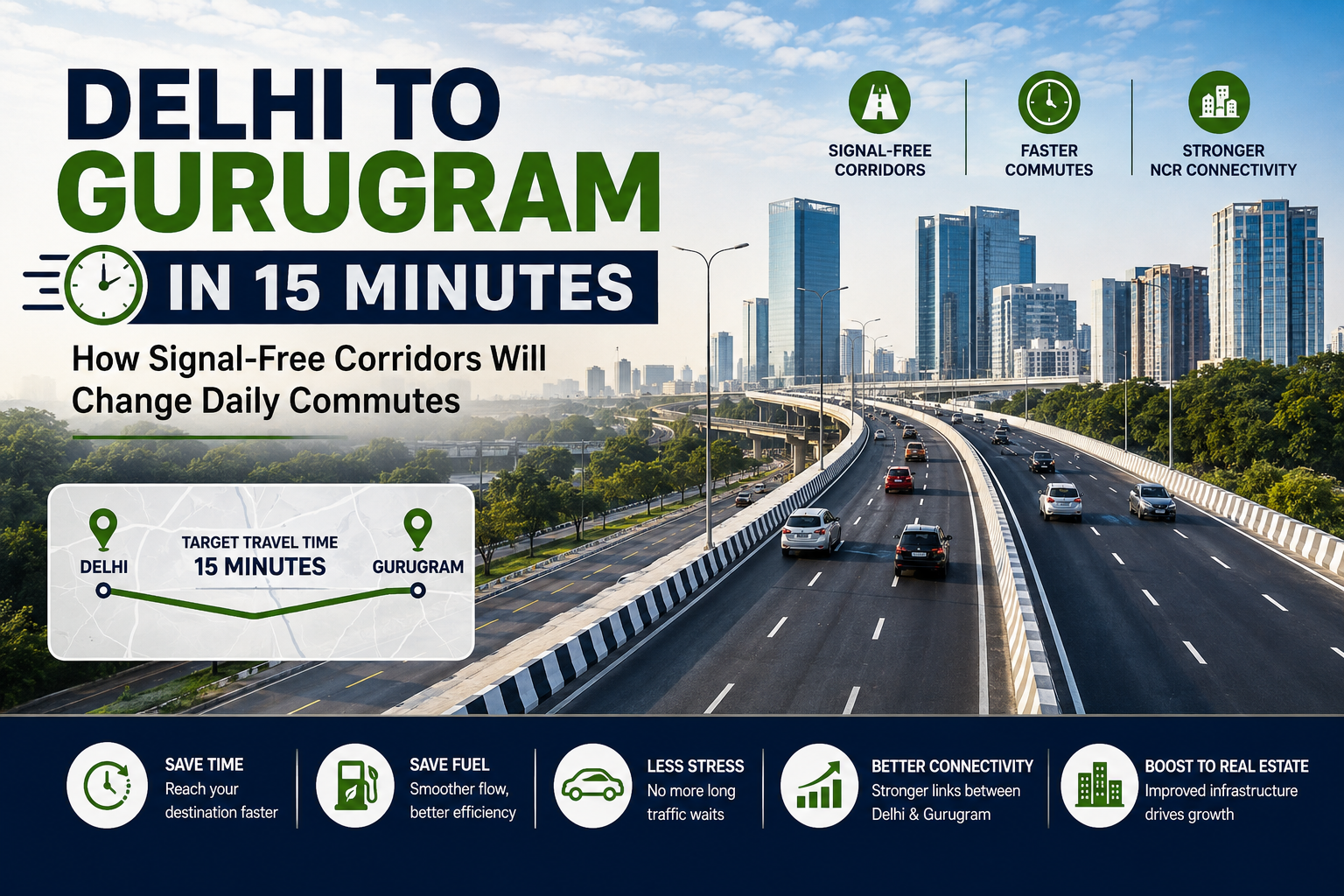
For years, travelling between Delhi and Gurugram has been an essential part of life for thousands of residents, professionals and businesses. While the two cities are geographically close, traffic congestion, busy intersections, bottlenecks and peak-hour delays can make the journey much longer than expected.
Now, a major transformation in NCR road infrastructure could change this experience.
The vision of Delhi to Gurugram in 15 minutes is gaining attention as authorities work on signal-free corridors, elevated roads, flyovers, interchanges and other mobility improvements. One of the major ideas is to reduce interruptions caused by traffic signals and congested junctions, particularly along important routes connecting South Delhi with Gurugram.
Recent reports have described plans aimed at bringing peak-hour travel between Delhi and Gurugram closer to 15 minutes through signal-free infrastructure.
But what exactly does this mean for daily commuters?
Could the Delhi-Gurugram journey really become significantly faster? And how could better connectivity affect residential areas, commercial hubs and real estate demand?
Let’s understand.
Why Delhi to Gurugram Travel Takes So Long
Delhi and Gurugram are among the most important economic centres in the National Capital Region. Gurugram has developed into a major corporate and commercial destination, while Delhi remains a key centre for government, business, education and employment.
This creates a huge daily movement of people between the two cities.
The problem is not simply the distance. Traffic signals, intersections, merging traffic, bottlenecks and peak-hour congestion can add significant time to an otherwise relatively short journey.
Routes around MG Road, NH-48 and other important connecting roads can experience heavy traffic during morning and evening office hours.
This is why simply widening roads is not always enough. The objective is increasingly to create continuous, high-capacity movement corridors where traffic can bypass major intersections instead of repeatedly stopping.
That is where signal-free infrastructure becomes important.
What Does a Signal-Free Corridor Mean?
A signal-free corridor is designed to allow vehicles to move through a route with minimal stopping at traffic lights.
Instead of making vehicles stop at multiple intersections, infrastructure such as:
- Flyovers
- Elevated roads
- Underpasses
- Grade separators
- Interchanges
- U-turns
- Service roads
can be used to separate traffic flows.
The objective is not necessarily to remove every traffic signal from an entire city. Instead, major bottlenecks are redesigned so that through-traffic can continue moving while local traffic uses alternative lanes or junction arrangements.
Delhi itself has been implementing signal-free stretches using measures such as removing redundant signals, rationalising intersections and improving U-turn arrangements.
For Delhi-Gurugram connectivity, similar infrastructure improvements could make an important difference.
Delhi to Gurugram in 15 Minutes: What Is Driving the Vision?
The proposed 15-minute commute is linked to a broader effort to improve connectivity between South Delhi and Gurugram.
The Mehrauli-Gurugram Road (MG Road) is particularly important because it directly connects South Delhi with Gurugram and serves a large volume of daily traffic.
Plans reported in 2026 have focused on making major corridors more efficient through flyovers and advanced interchanges at congested locations. The objective is to reduce peak-hour journey times substantially.
Another important development is the planned Southern Peripheral Road (SPR) elevated corridor.
According to the Gurugram Metropolitan Development Authority, a ₹755-crore project has been proposed for a 4.2-km signal-free elevated corridor between Vatika Chowk and NH-48. The project includes an elevated 4+4 lane corridor along with service roads and ramps.
Together, projects like these are part of a larger strategy to improve movement across Gurugram and its connections with Delhi and other NCR destinations.
Major Infrastructure Projects Supporting Better Connectivity
The 15-minute Delhi-Gurugram vision should not be viewed as the result of just one road project. NCR connectivity is evolving through several road and public transport initiatives.
1. MG Road Improvements
MG Road is one of the most important links between South Delhi and Gurugram.
Traffic bottlenecks on this route can have a direct impact on commuters travelling between the two cities.
Making the corridor more signal-free through appropriate flyovers, interchanges and junction improvements could help reduce unnecessary stops and improve traffic flow.
2. SPR Elevated Corridor
The proposed SPR elevated corridor is another major development.
The planned 4.2-km elevated corridor between Vatika Chowk and NH-48 is intended to create a signal-free movement layer above ground-level traffic.
This can be particularly important for Gurugram because the city has expanded rapidly toward its southern sectors.
Better SPR connectivity could help connect residential developments, commercial areas and major highways more efficiently.
3. Dwarka Expressway Connectivity
Dwarka Expressway has become an important part of the wider Delhi-Gurugram connectivity network.
Its strategic location provides an alternative connection between Delhi and New Gurugram and links with other major roads.
As surrounding residential and commercial development continues, improved connections between Dwarka Expressway, NH-48 and internal Gurugram roads can become increasingly important.
4. South Delhi–Gurugram Infrastructure
Another proposed project is a 4-km signal-free flyover on SSN Marg, which is intended to improve movement between South Delhi and Gurugram. Reports in June 2026 said the project was expected to reduce travel time along the relevant stretch significantly.
Such projects demonstrate how authorities are looking beyond conventional road widening and using grade-separated infrastructure to tackle congestion.
5. Public Transport Connectivity
Road infrastructure is only one part of the solution.
Gurugram is also getting a major proposed metro expansion. The Gurugram Metro Rail Limited corridor is planned as a 28.5-km elevated route from Millennium City Centre to Cyber City, with a spur toward Dwarka Expressway.
The corridor is designed to improve connections between Old Gurugram, New Gurugram, Udyog Vihar, Cyber City and areas around Dwarka Expressway.
This means the future of Delhi-Gurugram commuting could involve both faster roads and stronger public transport options.
How Signal-Free Corridors Could Change Daily Commutes
The biggest benefit could be time savings.
For office employees travelling between Delhi and Gurugram every day, even a 20–30 minute reduction in daily travel can make a significant difference over an entire month.
Consider a commuter who saves 30 minutes each way.
That could mean approximately one hour saved every working day.
Over 20 working days, that is around 20 hours per month.
That time could instead be spent with family, exercising, sleeping, working or pursuing personal activities.
Less Stop-and-Go Traffic
Frequent acceleration and braking can make driving stressful.
Signal-free corridors can help create smoother traffic movement by reducing unnecessary stops.
Better Fuel Efficiency
Repeated stopping and acceleration can increase fuel consumption. Smoother traffic flow may help reduce unnecessary fuel use, although actual savings will depend on traffic volume, driving behaviour and road conditions.
More Predictable Travel
For professionals, predictability can be just as important as speed.
Knowing that a journey generally takes a consistent amount of time makes it easier to plan:
- Office arrival
- Meetings
- School schedules
- Airport trips
- Business appointments
- Daily routines
Impact on Gurugram Real Estate
Improved connectivity can also influence real estate demand.
Historically, accessibility has been an important factor in property decisions. People often prefer homes that provide convenient access to workplaces, schools, highways, metro stations and commercial centres.
If Delhi-Gurugram travel becomes faster and more predictable, areas with improved access to major corridors could become more attractive to homebuyers and investors.
The effect could be especially relevant for areas connected to:
- SPR
- NH-48
- Dwarka Expressway
- MG Road
- Golf Course Extension Road
- Southern Gurugram
- New Gurugram
The proposed SPR elevated corridor itself is expected to improve mobility for residential and commercial clusters around the corridor.
However, infrastructure improvements do not automatically guarantee property price appreciation. Real estate performance also depends on supply, demand, project quality, amenities, employment growth and broader economic conditions.
Benefits for Gurugram’s Commercial Growth
Gurugram is already one of India’s major corporate destinations.
The city is home to offices, technology companies, financial institutions, startups, hospitality businesses and large commercial developments.
Better Delhi connectivity can make Gurugram more accessible to employees living in South Delhi and other parts of the NCR.
This could strengthen the city’s position as a corporate and employment hub.
Improved connectivity can also help businesses access a larger workforce without requiring employees to live very close to their workplaces.
The planned Gurugram Metro corridor is designed to connect residential and commercial areas with employment centres such as Udyog Vihar and Cyber City, further supporting this broader mobility network.
Will Delhi to Gurugram Really Take Only 15 Minutes?
This is an important question.
The phrase “Delhi to Gurugram in 15 minutes” should be understood as an infrastructure vision or targeted travel-time improvement rather than a guarantee that every journey between the two cities will always take exactly 15 minutes.
Actual travel time can depend on:
- Starting point
- Destination
- Time of day
- Weather
- Traffic volume
- Road closures
- Accidents
- Construction
- Entry and exit points
- Local congestion
Even a signal-free highway can experience congestion if traffic demand exceeds capacity.
Therefore, the real achievement would not simply be a headline travel time. The bigger goal is to create a faster, smoother and more predictable Delhi-Gurugram transportation network.
Environmental Benefits of Better Traffic Flow
Traffic congestion doesn’t only affect commuters.
Vehicles stuck in traffic spend more time idling and repeatedly accelerating and braking.
A smoother road network can potentially reduce unnecessary fuel consumption and vehicle emissions associated with congestion.
However, environmental benefits depend on several factors, including total traffic demand and whether improved roads encourage more private vehicle use.
This is why road projects should ideally be combined with efficient public transport.
Delhi-NCR is moving toward a multimodal transportation network, including metro and regional rail projects. NCRTC’s planned regional corridors include a proposed Gurugram-Faridabad-Noida-Greater Noida Namo Bharat corridor, designed to connect major NCR cities.
The Future of Delhi-Gurugram Connectivity
The future of NCR transportation is likely to be more integrated.
Instead of depending on a single highway, commuters could have multiple options:
Roads + Expressways + Metro + Namo Bharat + Interchanges + Signal-Free Corridors
This network approach is important because traffic problems cannot be solved by one road alone.
The proposed Gurugram Metro, for example, is planned to integrate with other transport systems, including the Delhi Metro, railway network, Rapid Metro and proposed regional rail connections.
At the regional level, NCRTC is also developing plans for additional Namo Bharat corridors, including a proposed Gurugram-Faridabad-Noida-Greater Noida connection.
This could gradually create a more connected NCR where people can travel between major employment and residential centres without relying entirely on private cars.
What This Means for Daily Commuters
For someone travelling between Delhi and Gurugram every day, the most important change may be time predictability.
A shorter and smoother commute could mean leaving home later, reaching work with less stress and returning home earlier.
For businesses, better connectivity can improve employee accessibility and potentially expand the practical labour market.
For residents, connectivity can increase the number of workplaces, schools, shopping centres and entertainment destinations that are realistically accessible within a reasonable travel time.
For real estate developers and investors, infrastructure can create new areas of interest—but decisions should always be based on multiple factors rather than connectivity alone.
Conclusion
The idea of Delhi to Gurugram in 15 minutes represents more than a shorter commute. It reflects a larger transformation taking place across the National Capital Region.
Signal-free corridors, elevated roads, flyovers, interchanges, expressways and expanding public transport are gradually changing the way Delhi and Gurugram connect with each other.
Projects such as the proposed SPR elevated corridor, improvements around major Delhi-Gurugram routes and the expansion of Gurugram’s metro network could help create a faster and more integrated transportation system.
The 15-minute target should therefore be seen as a vision for better mobility rather than a guaranteed door-to-door travel time.
If these infrastructure projects are successfully implemented and integrated with public transportation, the impact could extend far beyond commuting. They could influence business activity, residential preferences, commercial development and the overall growth pattern of Gurugram and the wider NCR.
For a region where time lost in traffic has become a daily challenge, even a significant reduction in travel time could make a major difference.