Haryana Metro Ridership Growth: What’s Driving the 2025–26 Surge?
The Haryana Metro ridership growth story has become an important indicator of changing travel patterns across the state. As cities such as Gurugram and Faridabad continue to expand, metro connectivity is increasingly becoming an essential part of daily urban mobility.
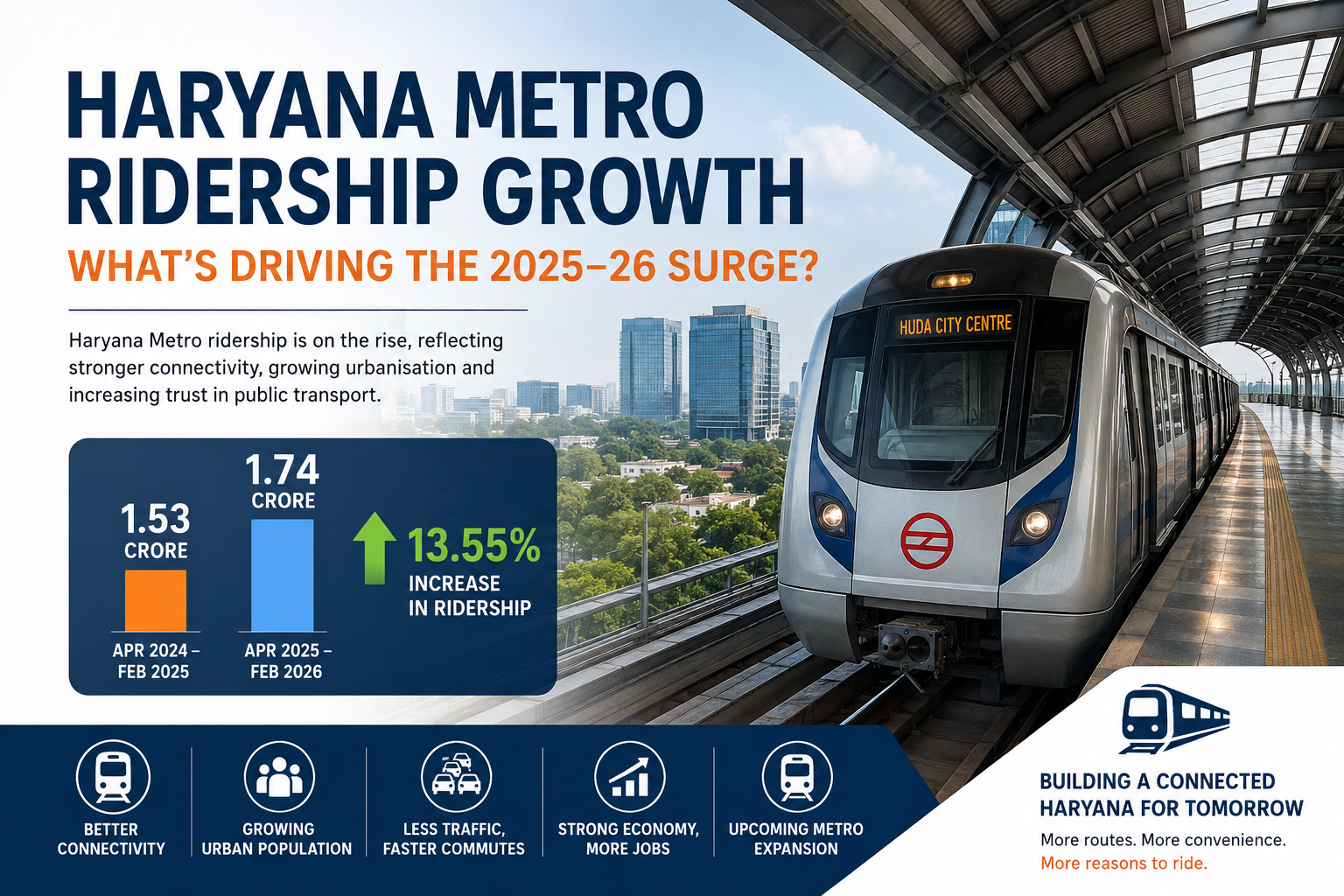
During April 2025 to February 2026, Haryana’s metro network recorded more than 1.74 crore passenger journeys, compared with around 1.53 crore during the corresponding period of the previous year. This represents a 13.55% increase in ridership. July recorded the highest monthly growth during the period, at 22.93%.
The increase is significant because it reflects more than just a rise in passenger numbers. It points toward growing dependence on public transportation, improving connectivity between residential and employment hubs, and increasing demand for reliable alternatives to road travel.
For Haryana, particularly the Gurugram-NCR region, metro expansion is also closely connected with commercial development, residential growth and future real estate opportunities.
Haryana Metro Ridership Growth at a Glance
The latest figures provide a clear picture of the changing demand for metro transportation in the state.
Haryana metro ridership growth
Passenger journeys recorded between April and February in the 2024–25 and 2025–26 periods.05M10M15M20MApr 2024–Feb 2025Apr 2025–Feb 2026
Source: Haryana Mass Rapid Transport Corporation figures reported in March 2026.
According to Haryana Mass Rapid Transport Corporation (HMRTC) figures, ridership increased from approximately 1.53 crore to 1.74 crore during the comparable period. Fare revenue also increased by 12.64% through January 2026, while non-fare revenue rose by 108%, supported by station-space monetisation, advertising and commercial activities.
These numbers suggest that the state’s urban transit ecosystem is becoming more active and commercially sustainable.
Why Is Haryana Metro Ridership Increasing?
Several factors are contributing to the Haryana Metro ridership growth. The trend is not being driven by one single development. Instead, it is the result of population growth, employment concentration, better connectivity, road congestion and expanding metro infrastructure.
1. Growing Urban Population and Employment
Haryana’s major urban centres have experienced rapid development over the past decade. Gurugram, in particular, has emerged as one of India’s leading corporate and employment hubs.
Thousands of employees travel every day between residential neighbourhoods and commercial districts. Areas around Cyber City, Golf Course Road, Udyog Vihar and other employment clusters generate significant daily travel demand.
As employment opportunities increase, the need for dependable public transportation also rises.
Metro systems can provide commuters with more predictable travel times than road-based transportation, particularly during peak traffic hours.
This is one of the fundamental reasons why Gurugram metro ridership continues to attract attention from urban planners and businesses.
2. Increasing Road Congestion
Road congestion is another important factor influencing public transport choices.
Gurugram has witnessed substantial growth in residential development, office spaces, retail destinations and commercial activity. The increasing number of private vehicles has added pressure to the city’s road network.
For daily commuters, unpredictable travel times can make road transportation challenging.
Metro services offer an alternative that is less affected by surface-level traffic conditions. As commuters become more conscious of time and convenience, metro transportation becomes increasingly attractive.
The recent rise in ridership therefore reflects not only infrastructure growth but also changing commuter preferences.
3. Better Metro Connectivity
Connectivity plays a major role in determining whether people choose public transport.
Gurugram already benefits from the Delhi Metro Yellow Line and Rapid Metro connectivity. The network connects important employment and commercial locations, while integration with Delhi’s wider metro system allows passengers to travel between different parts of the NCR.
The planned Gurugram Metro expansion is expected to strengthen this network further.
The approved 28.5-km Gurugram Metro corridor will connect Millennium City Centre with Cyber City and include a spur towards the Dwarka Expressway side. The project is designed to improve connectivity between New Gurugram and Old Gurugram while connecting important residential and employment areas.
Better connectivity can create a positive cycle:
More connectivity → easier commuting → higher public transport adoption → increased ridership → stronger demand for further expansion.
4. Gurugram’s Corporate Ecosystem
Gurugram is one of the biggest contributors to Haryana’s economic activity.
The city houses offices of multinational companies, technology firms, financial institutions, startups and service-sector businesses. These employment centres generate substantial daily commuter movement.
Metro connectivity is especially valuable for employees who need to travel during peak office hours.
As more companies establish operations in Gurugram, demand for efficient transportation is likely to remain strong.
This makes Haryana Metro ridership growth particularly relevant for businesses, investors and real estate developers.
5. Expansion of Residential Areas
Gurugram’s residential growth has also changed travel patterns.
New residential developments are emerging across areas such as New Gurugram, Dwarka Expressway, Sohna Road and other growth corridors.
As residential communities expand farther from traditional employment centres, transportation connectivity becomes increasingly important.
A well-connected metro network can reduce the perceived distance between residential and commercial areas.
This is why metro infrastructure is increasingly becoming an important consideration for homebuyers and property investors.
Metro Connectivity and Haryana Real Estate
The relationship between transportation infrastructure and real estate development is particularly important in a growing city.
Properties located near established transportation networks often benefit from better accessibility. Improved connectivity can make residential and commercial areas more attractive to businesses, employees and investors.
For Gurugram, the upcoming metro network could create new development opportunities across areas that historically had weaker public transportation connectivity.
The approved Gurugram Metro corridor will pass through several important areas, including parts of Old Gurugram, residential sectors, Udyog Vihar and Cyber City.
This could support the development of new residential and commercial clusters along the corridor.
Why Metro Matters to Property Buyers
For homebuyers, proximity to metro stations can provide several practical benefits:
- Easier daily commuting
- Better access to employment hubs
- Reduced dependence on private vehicles
- Improved connectivity with other NCR locations
- Potentially stronger long-term demand for well-connected properties
However, metro connectivity should not be considered the only factor when evaluating a property. Location quality, developer credibility, infrastructure, pricing, amenities and future development plans should also be assessed.
Gurugram Metro Expansion Could Support Future Ridership
The future of Haryana Metro ridership growth is closely connected with the expansion of the network.
The planned Gurugram Metro corridor is expected to create a more integrated network across the city. According to the government’s project information, the corridor is designed for an estimated daily ridership of 5.34 lakh in 2026, rising to 7.26 lakh by 2031, subject to project development and demand assumptions.
The project’s detailed planning also anticipates increasing passenger demand over the longer term.
The revised DPR estimates maximum peak-hour passenger demand of 19,359 passengers per hour per direction in 2026, increasing to 27,263 by 2031 and 43,878 by 2051.
These projections demonstrate how transportation planning is being aligned with Gurugram’s expected urban and economic expansion.
Sector 56–Pachgaon Metro: Another Potential Growth Corridor
Beyond the existing network and the Gurugram Metro project, proposed future connectivity could further change the city’s transportation landscape.
A proposed Sector 56–Pachgaon Metro corridor is expected to cover around 36 km with 28 elevated stations, connecting areas including Global City and IMT Manesar.
If developed, such a corridor could connect residential areas with major employment and industrial destinations.
IMT Manesar, for example, is an important industrial and employment centre. Better public transport connectivity could help employees travel between residential areas and workplaces while potentially supporting future development along the corridor.
This is why upcoming infrastructure projects deserve close attention when analysing Haryana’s real estate and urban growth story.
Metro, Namo Bharat and Integrated NCR Connectivity
Haryana’s future transportation strategy is not limited to conventional metro services.
Metro corridors are increasingly being considered alongside Namo Bharat/RRTS, railways and other public transport systems to create a more integrated regional network.
In August 2026, the Ministry of Housing and Urban Affairs reported that the Delhi-Ghaziabad-Meerut Namo Bharat corridor had become fully operational and had carried more than 3.8 crore commuters since the beginning of operations. The corridor also has multimodal integration with metro lines, railway stations and bus terminals.
For the wider NCR, such integration highlights an important trend: commuters increasingly need seamless connections between different transport systems rather than isolated routes.
For Haryana, future metro and RRTS connectivity could make intercity and intra-city travel more convenient.
What Does the Ridership Growth Mean for Haryana?
The rise in passenger numbers has several implications for the state.
Stronger Public Transport Adoption
The increase suggests that more people are willing to use metro services for everyday travel.
Greater Infrastructure Demand
As ridership increases, additional routes, stations and interchange facilities become more important.
Support for Sustainable Mobility
Higher public transport usage can help reduce dependence on private vehicles and support more efficient urban mobility.
Opportunities for Transit-Oriented Development
Areas around major transit corridors may attract greater residential, commercial and retail activity.
Better Accessibility for Businesses
Improved transportation can make employment hubs more accessible to a larger workforce.
How Metro Growth Could Influence Gurugram’s Property Market
For the real estate sector, transportation infrastructure can be a major growth catalyst.
When a new metro corridor connects previously underserved locations, accessibility can improve. This can attract developers, businesses and residents.
For example, a future metro station near a residential or commercial project could make the location more convenient for daily commuters.
However, investors should distinguish between operational metro connectivity and proposed connectivity.
A project being announced does not automatically mean that property values will increase. Actual benefits depend on project execution, station location, timelines, surrounding infrastructure and broader market conditions.
Therefore, buyers should evaluate the complete development ecosystem rather than relying solely on a proposed metro route.
What Could Drive Haryana Metro Ridership Further?
The current growth could continue if several supporting factors develop together.
Expansion of Metro Routes
More stations and corridors can bring metro services closer to new residential and employment clusters.
Improved Interchange Facilities
Easy transfers between metro, railway, bus and RRTS services can encourage more people to use public transportation.
Growing Employment Centres
New corporate and industrial hubs can generate additional commuter demand.
Increasing Urbanisation
As Haryana’s cities expand, public transport will become increasingly important for managing mobility.
Better Last-Mile Connectivity
Metro ridership can increase further when commuters have convenient options such as feeder buses, walking infrastructure, cycling facilities, taxis and other last-mile services.
The Road Ahead for Haryana Metro Ridership Growth
The Haryana Metro ridership growth recorded during 2025–26 is more than a short-term passenger statistic. It reflects a broader transformation in how people move across Haryana’s major urban centres.
The increase of 13.55% in passenger traffic between April 2025 and February 2026 demonstrates growing demand for organised public transportation.
At the same time, new infrastructure projects could significantly expand the role of metro transportation in the years ahead.
Gurugram’s proposed metro network, future corridor development and integration with wider NCR transportation systems could make public transport increasingly important for residents, employees and businesses.
For the real estate sector, this trend is equally important. Better connectivity can influence where people choose to live, where companies establish offices and where developers focus their future projects.
Conclusion
The Haryana Metro ridership growth seen in 2025–26 is being driven by a combination of factors: increasing urbanisation, growing employment centres, road congestion, improving connectivity and expanding public transportation infrastructure.
With more than 1.74 crore passenger journeys recorded between April 2025 and February 2026, compared with approximately 1.53 crore during the previous year’s corresponding period, the direction is clearly positive.
Gurugram remains at the centre of this transformation, with its corporate ecosystem, expanding residential areas and upcoming metro infrastructure creating strong demand for efficient transportation.
As Haryana continues developing its metro and regional transit network, connectivity is likely to become an increasingly important factor in the state’s urban development and real estate landscape.
For homebuyers, investors and businesses, the key takeaway is simple: where transportation infrastructure improves, accessibility improves and accessibility can play an important role in shaping the next phase of urban growth.