How NHAI’s Road Projects Are Transforming Delhi–Gurgaon Connectivity
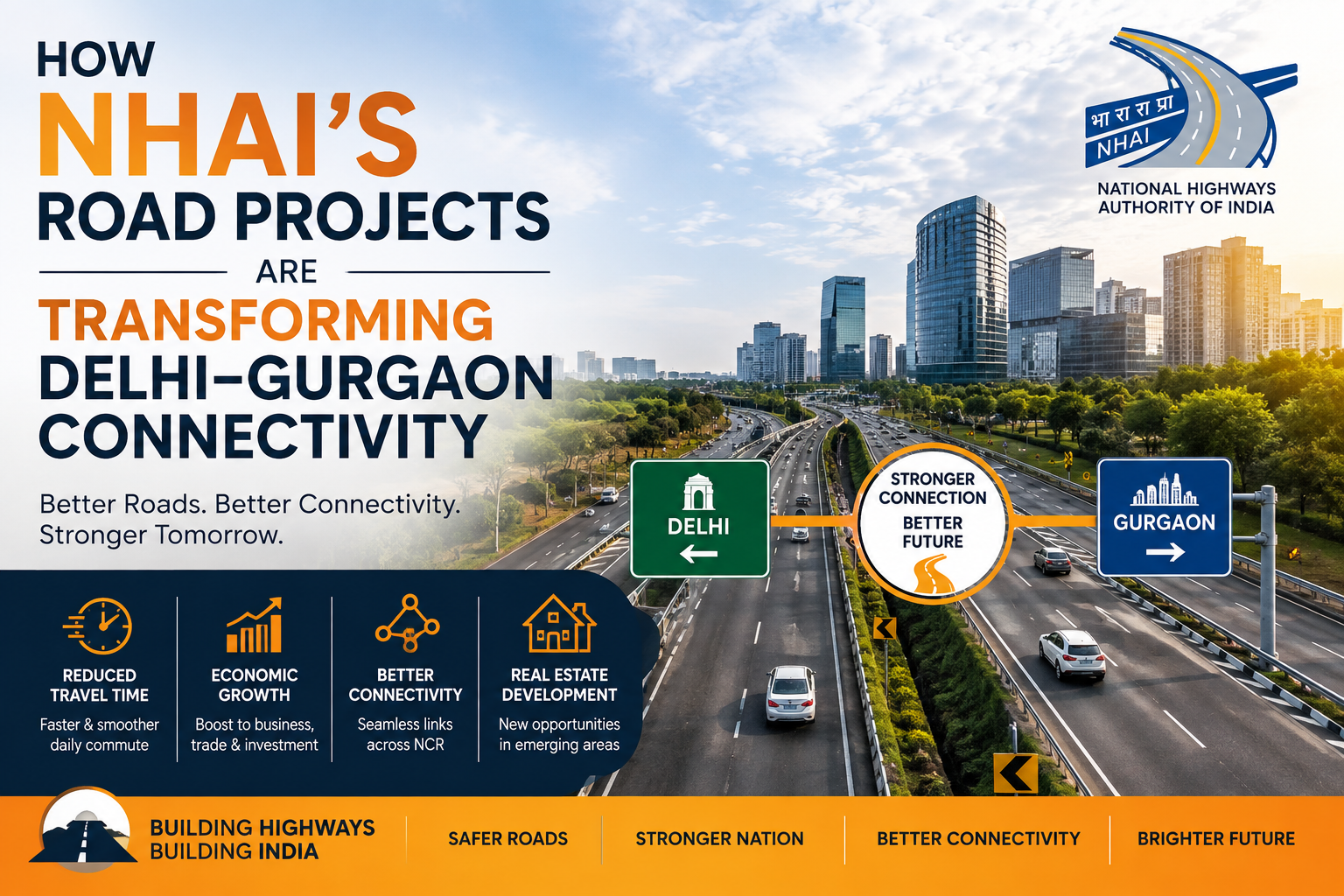
Delhi and Gurgaon are two of the most important economic centres in the National Capital Region (NCR). With thousands of professionals, businesses, commuters and visitors travelling between the two cities every day, efficient road connectivity has become essential for the region’s economic and residential growth.
Over the years, several highway and road infrastructure initiatives have been developed to improve connectivity between Delhi, Gurgaon and surrounding areas. The National Highways Authority of India (NHAI) has played an important role in developing and upgrading major road corridors across the NCR.
The NHAI Road Projects Transforming Delhi-Gurgaon Connectivity are not only focused on improving commuting conditions. Better roads can also support logistics, commercial activity, employment opportunities and real estate development in areas located along important transportation corridors.
From expressways and highway upgrades to new road links and improved interchanges, infrastructure development is gradually changing how people move across Delhi-NCR.
In this blog, we explore how NHAI-led road development is influencing Delhi-Gurgaon connectivity and what it could mean for commuters, businesses and the real estate market.
Why Delhi-Gurgaon Connectivity Matters
Gurgaon, officially Gurugram, has developed into a major corporate and commercial hub. The city is home to offices, technology companies, financial institutions, retail destinations, residential communities and industrial areas.
Delhi, meanwhile, remains a major administrative, commercial and transportation centre.
The close economic relationship between the two cities means that reliable connectivity is extremely important. A large number of people travel between Delhi and Gurgaon for work, business, education and other daily activities.
Traffic congestion, bottlenecks and increasing vehicle volumes can create challenges for commuters. This makes continued investment in road infrastructure particularly important.
Improved connectivity can provide several benefits:
- Better movement between Delhi and Gurgaon
- Improved access to employment centres
- More efficient movement of goods
- Better connectivity to airports and major highways
- Improved access to developing residential areas
- Greater connectivity between emerging NCR locations
This is why road infrastructure has become one of the key factors influencing Gurgaon’s future development.
How NHAI Road Projects Are Transforming Delhi-Gurgaon Connectivity
1. Improving Travel Efficiency
One of the biggest objectives of highway development is to make travel more efficient.
Upgraded roads, better junctions, improved interchanges and strategically planned road links can help vehicles move more smoothly. While traffic conditions can still vary depending on time and location, improved infrastructure provides additional capacity for growing traffic volumes.
For daily commuters between Delhi and Gurgaon, better road infrastructure can make journeys more predictable and improve accessibility to major business districts.
2. Strengthening Connections Between Major Highways
Delhi-Gurgaon connectivity does not depend on a single road.
The region is connected through several important highways, expressways and arterial roads. NHAI projects can improve connections between these transportation corridors, allowing traffic to move more efficiently between different parts of NCR.
Better integration between major routes is particularly important for Gurgaon because the city connects Delhi with several important parts of Haryana and the wider NCR.
This can also improve access to locations such as Manesar, Sohna and other developing areas.
3. Supporting Gurgaon’s Expanding Business Ecosystem
Gurgaon has become one of India’s leading corporate destinations.
The city has a large concentration of offices, business parks, shopping centres, hotels and commercial developments. As businesses expand, the demand for efficient transportation also increases.
Improved road infrastructure can support businesses by making offices easier to access for employees, customers, suppliers and service providers.
Better connectivity can also help strengthen Gurgaon’s position as a preferred destination for companies looking for access to Delhi, the airport and other NCR markets.
4. Better Access to Delhi International Airport
Connectivity to the airport is another major factor in Gurgaon’s infrastructure story.
Gurgaon is strategically located close to Indira Gandhi International Airport. Efficient road connections between the city, Delhi and the airport are important for corporate travellers, tourists and businesses.
Improved highway infrastructure can make airport access more convenient from different parts of Gurgaon and nearby areas.
For commercial developments, hotels and corporate offices, proximity to efficient airport connectivity can be an important advantage.
5. Encouraging Development Along Emerging Corridors
Road infrastructure often influences where new development takes place.
When a previously less-connected area receives better road access, it can become more attractive for residential, commercial and industrial development.
This pattern can already be seen across different parts of Gurgaon and the wider NCR, where infrastructure development has accompanied urban expansion.
New road links can improve accessibility to emerging sectors and create opportunities for future development.
However, buyers and investors should evaluate each location individually rather than assuming that every infrastructure project will automatically result in higher property prices.
6. Boosting Gurgaon Real Estate Demand
The relationship between infrastructure and real estate is particularly important in Gurgaon.
Homebuyers often consider connectivity when selecting a property. A residential project with convenient access to major roads, offices, schools, shopping destinations and public transportation can be more attractive than a similar property in a less-connected location.
For investors, improved connectivity can potentially increase the long-term attractiveness of developing areas.
The NHAI Road Projects Transforming Delhi-Gurgaon Connectivity could therefore have an indirect influence on property demand by improving accessibility to different parts of the region.
7. Supporting Commercial Real Estate
The impact of better roads is not limited to residential property.
Commercial real estate can also benefit from improved connectivity. Retail centres, office developments, warehouses, hotels and mixed-use projects generally require convenient access for customers, employees and logistics operations.
As road networks improve, previously peripheral areas may become more commercially viable.
For Gurgaon, this could support the continued expansion of commercial activity beyond established business districts.
8. Improving Regional Logistics and Freight Movement
Delhi-NCR is one of India’s most important consumption and business markets. Efficient road infrastructure is essential for the movement of goods between warehouses, industrial areas, businesses and consumers.
Improved highways and road links can support logistics operations by providing better connections between major commercial and industrial zones.
Gurgaon and nearby Manesar have important industrial and logistics activity, making road infrastructure particularly relevant to the region’s economic growth.
Better connectivity can help businesses manage transportation more efficiently and strengthen the wider supply chain.
9. Creating Better Connectivity for Developing Areas
Gurgaon continues to expand geographically.
New residential sectors, commercial hubs and infrastructure corridors are developing beyond the city’s traditional centres. As urbanisation continues, connectivity becomes increasingly important.
Road projects can help integrate emerging areas with established parts of Gurgaon and Delhi.
This can provide residents with better access to workplaces, educational institutions, healthcare facilities, retail destinations and other essential services.
10. Reducing Pressure on Existing Routes
Another important benefit of developing additional road links is the possibility of distributing traffic across multiple routes.
When most vehicles depend on a limited number of corridors, congestion can become a major challenge.
Strategic road connections can provide alternative routes and improve network resilience.
The effectiveness of such projects depends on design, traffic management, integration with existing roads and actual usage patterns. Nevertheless, expanding the road network remains an important part of planning for a growing metropolitan region.
Major Connectivity Corridors Around Delhi and Gurgaon
Delhi-Gurgaon connectivity is supported by several important transportation corridors.
Delhi-Gurgaon Expressway
The Delhi-Gurgaon Expressway is one of the most important road connections between the two cities. It supports a large volume of daily traffic and provides direct access between Delhi and major parts of Gurgaon.
Dwarka Expressway
Dwarka Expressway has emerged as an important alternative connectivity corridor between Delhi and Gurgaon. Its strategic location has also contributed to increased development interest in areas along the corridor.
Southern Peripheral Road
Southern Peripheral Road connects several important parts of Gurgaon and provides access to major highways and developing sectors.
Northern Peripheral Road
Commonly known as Dwarka Expressway, this corridor has become an important part of Gurgaon’s expanding road network and is influencing development across several sectors.
Sohna Road and Peripheral Connectivity
Improved connections toward Sohna and other southern parts of Gurgaon are supporting the expansion of the city’s residential and commercial footprint.
Impact on Gurgaon’s Future Real Estate Market
Infrastructure development is one of several factors that can influence real estate demand.
For Gurgaon, road connectivity can play an important role because many residential and commercial developments are located around major transportation corridors.
Areas with good connectivity may attract:
- Homebuyers looking for easier commuting
- Professionals working in Gurgaon and Delhi
- Businesses seeking accessible office locations
- Retail and hospitality developments
- Warehousing and logistics companies
- Long-term property investors
However, infrastructure should not be the only factor considered when evaluating a property.
Buyers should also examine developer reputation, project approvals, construction quality, amenities, surrounding infrastructure, rental demand and overall investment fundamentals.
What This Means for Homebuyers and Investors
For homebuyers, improved connectivity can mean easier daily commuting and better access to essential facilities.
For investors, infrastructure-led development can create opportunities in emerging areas. But property investment always involves market risks, and future infrastructure benefits may take time to materialise.
Before investing, buyers should research:
- Current road connectivity
- Planned infrastructure projects
- Construction timelines
- Distance from employment hubs
- Public transportation availability
- Nearby schools and healthcare facilities
- Existing and upcoming commercial development
- Property prices and rental demand
- Developer track record
- Legal and regulatory approvals
A location with strong current infrastructure and realistic future development prospects can offer a more balanced investment opportunity.
Future of Delhi-Gurgaon Connectivity
The future of Delhi-Gurgaon connectivity will likely depend on the continued development of highways, expressways, arterial roads and multimodal transportation systems.
As Gurgaon continues to grow, transportation planning will need to keep pace with increasing population, employment and vehicle volumes.
Future infrastructure development could focus on:
- Better highway interchanges
- Additional road capacity
- Improved connectivity to peripheral areas
- Better integration of expressways
- Smarter traffic management
- Improved airport connectivity
- Stronger connections with other NCR cities
The goal is not simply to construct more roads but to create a better-connected regional transportation network.
Conclusion
The NHAI Road Projects Transforming Delhi-Gurgaon Connectivity represent an important part of the broader infrastructure development taking place across Delhi-NCR.
Better highways, road links and interchanges can improve accessibility, support business activity, strengthen logistics networks and open up new opportunities for residential and commercial development.
For Gurgaon, connectivity is particularly significant because the city’s growth is closely connected to Delhi, the airport, Manesar, Sohna and other major NCR destinations.
As infrastructure continues to develop, areas with strong connectivity could become increasingly attractive to homebuyers, businesses and investors. However, property decisions should always be based on comprehensive research rather than connectivity alone.
For anyone following the Gurgaon real estate market, keeping track of major NHAI projects and road infrastructure developments can provide valuable insight into the region’s future growth.