How the Delhi-Mumbai Expressway Could Impact NCR Property Prices
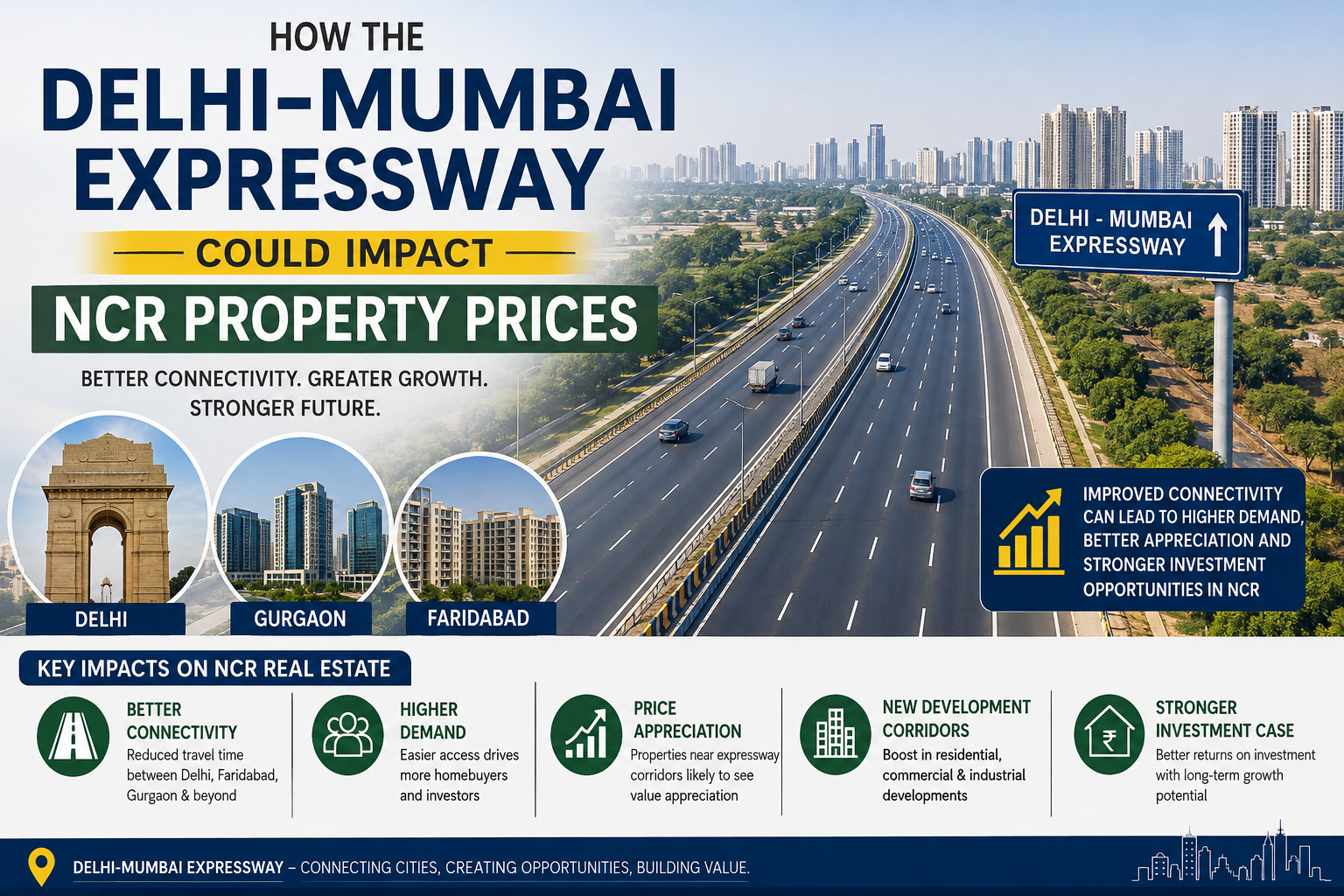
Infrastructure has always played an important role in shaping real estate markets. Better roads, expressways, metro networks and airport connectivity can reduce travel time, improve accessibility and make previously overlooked locations more attractive to homebuyers and investors.
The Delhi-Mumbai Expressway is one of the most significant infrastructure projects influencing connectivity across the National Capital Region (NCR). Its Delhi-side connectivity includes the DND Flyway, Jaitpur and Faridabad corridor before connecting toward the wider expressway network. In August 2026, the National Highways Authority of India (NHAI) opened a 9-km DND Flyway–Jaitpur stretch on a trial basis, aimed at improving connectivity between Delhi and Faridabad and easing congestion on existing routes.
For the real estate market, the bigger question is: what could this improved connectivity mean for NCR property prices?
The impact is unlikely to be uniform across the entire region. Areas located closer to new access points, established residential corridors and upcoming infrastructure projects could potentially benefit more than locations that remain poorly connected.
This article explores the potential Delhi-Mumbai Expressway impact on NCR property prices, the areas that could benefit, changing buyer preferences and what investors should consider before making a decision.
What Is the Delhi-Mumbai Expressway?
The Delhi-Mumbai Expressway is a major access-controlled highway designed to improve connectivity between the Delhi-NCR region and western India.
The Delhi-side corridor begins around the DND Flyway in Delhi and passes through areas including Jaitpur and Faridabad before connecting toward the broader expressway network. According to recent reports, the DND-to-Jaitpur section is intended to provide a smoother route for commuters travelling between parts of Delhi and Faridabad.
Its importance goes beyond simply reducing travel time. Large-scale infrastructure can influence where people choose to live, where businesses establish operations and where developers launch new projects.
For real estate, this creates a potential connectivity premium.
When a location becomes easier to reach, demand can increase if the area also has suitable housing, employment opportunities, social infrastructure and development potential.
Delhi-Mumbai Expressway Impact on NCR Property Prices
The Delhi-Mumbai Expressway impact on NCR property prices could emerge through several interconnected factors.
1. Improved Connectivity Can Increase Property Demand
Connectivity is one of the most important factors considered by modern homebuyers.
A property may become more attractive when residents can access major employment hubs, commercial centres, airports and neighbouring cities more conveniently.
The DND-Jaitpur stretch is particularly relevant because it is designed to improve movement between Delhi and Faridabad while providing access toward the larger Delhi-Mumbai Expressway corridor.
As accessibility improves, buyers who previously preferred locations closer to established Delhi or Gurgaon hubs may start considering emerging areas where they can potentially get larger homes at relatively competitive prices.
This can gradually increase demand in strategically located micro-markets.
2. Faridabad Could Gain Greater Real Estate Attention
Among NCR markets, Faridabad could be one of the locations to watch closely because of its direct relationship with the DND-Jaitpur-Faridabad connectivity corridor.
Recent market reports already describe Faridabad as a relatively affordable major NCR residential market compared with Gurgaon and Noida, although prices vary significantly by sector and project.
Improved expressway connectivity could make locations in and around Faridabad more attractive to:
- First-time homebuyers
- End-users working in Delhi
- Investors seeking emerging markets
- Families looking for larger homes
- Businesses requiring road connectivity
- Buyers priced out of premium Delhi micro-markets
However, connectivity alone does not guarantee price appreciation. The strongest impact is generally more likely in locations where infrastructure is combined with quality residential projects, schools, hospitals, retail facilities and employment opportunities.
3. Greater Accessibility Could Create a Connectivity Premium
Real estate prices are influenced by multiple factors, including location, construction quality, developer reputation, amenities, supply and demand.
Connectivity is another major factor.
When a new expressway or transport corridor reduces perceived distance between two locations, buyers may become willing to consider properties farther from their workplace.
For example, if commuting from a residential area to a major employment centre becomes easier, the location can become more attractive even if it is not geographically close.
This can create what is commonly called a connectivity premium.
Over time, properties located near important entry and exit points may receive greater attention than similar properties located farther away.
4. Impact on Property Prices Could Be Gradual
One important point for investors is that infrastructure announcements do not automatically translate into immediate property-price increases.
Property markets typically respond in stages.
Stage 1: Announcement
Developers and investors begin tracking the project.
Stage 2: Construction
Market sentiment starts changing as physical progress becomes visible.
Stage 3: Connectivity Becomes Operational
Actual travel-time benefits become measurable.
Stage 4: Supporting Development
Commercial centres, housing projects, schools, retail and other infrastructure begin developing around the corridor.
Stage 5: Market Maturity
The location becomes an established residential or commercial destination.
Therefore, the Delhi-Mumbai Expressway impact on NCR property prices should be evaluated from a long-term perspective rather than simply expecting an immediate jump after an infrastructure milestone.
5. Gurgaon Could Benefit Indirectly
The expressway’s influence may extend beyond locations directly adjacent to its Delhi-Faridabad corridor.
Gurgaon is already one of NCR’s strongest residential markets, with major demand concentrated around corridors such as Dwarka Expressway, Golf Course Extension Road, New Gurgaon and Manesar. JLL’s Q2 2026 Delhi-NCR residential report says Gurgaon accounted for 43% of NCR residential sales during the quarter.
Improved regional connectivity could strengthen links between different NCR sub-markets.
This could be particularly relevant for locations such as:
- Sohna
- Manesar
- New Gurgaon
- Southern Gurgaon
- Faridabad
- Nuh
However, the effect will vary depending on the actual travel routes and accessibility from each location.
6. Commercial Real Estate Could Also Benefit
The impact of the Delhi-Mumbai Expressway is not limited to residential property.
Improved highway connectivity can be important for:
- Warehousing
- Logistics parks
- Industrial developments
- Commercial centres
- Retail hubs
- Office spaces
- Hospitality projects
Businesses that depend heavily on road transportation may prefer locations with direct access to major highways.
As commercial activity increases, residential demand can also follow because employees and supporting businesses require housing.
This creates a potential cycle:
Better Connectivity → Business Activity → Employment → Housing Demand → Real Estate Growth
This is one reason infrastructure corridors are closely watched by real estate developers and investors.
7. Development Around Faridabad Could Accelerate
The DND-Jaitpur-Faridabad corridor could become increasingly important as different infrastructure projects develop around it.
Recent reporting has highlighted additional connectivity initiatives linking Delhi, Faridabad and other NCR destinations. A proposed link toward Jewar airport is also expected to improve regional connectivity once developed.
Such projects can increase the strategic importance of locations that sit between established urban centres and emerging infrastructure hubs.
For real estate investors, this means that the question should not simply be:
“Is the property near the Delhi-Mumbai Expressway?”
Instead, investors should ask:
“How many major infrastructure connections can this property benefit from?”
That distinction is important.
8. Homebuyers May Look Beyond Traditional Premium Locations
Delhi and Gurgaon have traditionally commanded premium property prices in many established locations.
As prices rise in established markets, buyers often explore emerging corridors where they can potentially find:
- Larger apartments
- Independent floors
- Plots
- Commercial spaces
- New residential projects
- Better amenities at comparatively accessible prices
Infrastructure can make these emerging areas more appealing.
For value-conscious buyers, the combination of affordability + connectivity + future development can become an important purchasing consideration.
9. Rental Demand Could Increase in Growth Corridors
Property appreciation is not the only possible benefit.
Improved connectivity can also influence rental demand.
If a developing area attracts new offices, businesses, educational institutions or industrial activity, more employees may seek rental accommodation nearby.
This can create opportunities for property owners who purchase in locations with strong employment and infrastructure prospects.
However, rental returns should always be evaluated using actual local rental demand rather than assuming that an expressway will automatically increase rents.
10. Why Investors Should Study Micro-Markets
One of the biggest mistakes investors can make is treating the entire NCR property market as one market.
It isn’t.
Even within the same city, property prices can vary substantially depending on:
- Distance from the expressway
- Access roads
- Metro connectivity
- Project quality
- Developer reputation
- Social infrastructure
- Employment hubs
- Land availability
- Future development plans
- Existing residential demand
For example, a property located several kilometres from an expressway but connected through a good arterial road may perform differently from a property that is geographically closer but difficult to access.
Therefore, micro-market analysis is more important than simply buying because a property is advertised as “near the Delhi-Mumbai Expressway.”
Delhi-Mumbai Expressway and NCR Real Estate: What Could Happen Next?
The long-term impact will depend on how quickly supporting infrastructure and urban development catch up with improved road connectivity.
The strongest growth could potentially occur where multiple factors come together:
Expressway + Metro/Transit + Employment + Housing + Social Infrastructure
This combination creates a stronger foundation for sustainable real estate demand.
NCR’s broader residential market is already seeing strong activity in several major markets. JLL reported that Delhi-NCR recorded 10,021 residential sales in Q2 2026, with Gurgaon leading the region, while Faridabad also saw new residential supply growth.
This suggests that infrastructure-led growth is taking place within an already active regional property market.
Should You Invest Near the Delhi-Mumbai Expressway?
There is no universal answer.
The expressway can be considered a positive infrastructure factor, but it should not be the only reason to purchase a property.
Before investing, buyers should evaluate:
Location
Check the property’s actual distance and road access to the expressway.
Developer
Research the developer’s track record and project delivery history.
Legal Documentation
Verify land ownership, approvals, RERA registration where applicable and other required documentation.
Price
Compare the property with similar projects in nearby locations.
Rental Demand
Check existing rental demand rather than relying solely on future expectations.
Social Infrastructure
Look for schools, hospitals, retail, entertainment and daily-use facilities.
Future Infrastructure
Study planned roads, metro corridors, airports and commercial developments.
Exit Potential
Consider whether there will be sufficient buyer demand when you eventually want to sell.
Potential Benefits and Risks
| Potential Benefits | Potential Risks |
|---|---|
| Improved connectivity | Development may take time |
| Higher buyer interest | Prices may already reflect future expectations |
| Better access to employment hubs | Infrastructure delays are possible |
| Potential rental demand | Not every nearby location will benefit equally |
| Commercial development potential | Oversupply can affect returns |
| Greater investor attention | Speculative pricing can increase risk |
The key takeaway is that infrastructure creates opportunity, but location selection determines how much of that opportunity a property can capture.
Future Outlook for NCR Property Prices
The Delhi-Mumbai Expressway impact on NCR property prices is likely to be more visible over the medium to long term.
The recently opened DND-Jaitpur stretch is an important connectivity milestone, but the broader impact will depend on the completion and integration of related road networks and surrounding developments.
Areas such as Faridabad and other southern NCR corridors could receive increased attention as connectivity improves.
At the same time, established markets such as Gurgaon and Noida will continue to have their own demand drivers, including employment, metro connectivity, airports and commercial development.
Rather than expecting one expressway to transform the entire NCR property market overnight, investors should look for specific micro-markets where infrastructure, affordability and genuine end-user demand overlap.
Conclusion
The Delhi-Mumbai Expressway Impact on NCR Property Prices could become an important real estate story over the coming years.
The opening of the 9-km DND Flyway-Jaitpur stretch represents another step toward improved connectivity between Delhi and Faridabad and the wider expressway network.
Better connectivity can encourage residential demand, support commercial development, improve accessibility and increase the attractiveness of emerging real estate corridors.
Faridabad and strategically located southern NCR markets could be among the areas worth watching, while Gurgaon, Sohna and other connected markets may experience indirect benefits.
For buyers and investors, however, the most important lesson is simple: do not invest solely because an expressway is nearby. Look at the complete picture connectivity, infrastructure, developer quality, pricing, rental demand, social amenities and long-term development potential.
As NCR continues to expand, infrastructure will remain one of the key factors shaping where people live, businesses operate and property values grow.