Haryana Metro Ridership on the Rise: What It Means for Urban Growth
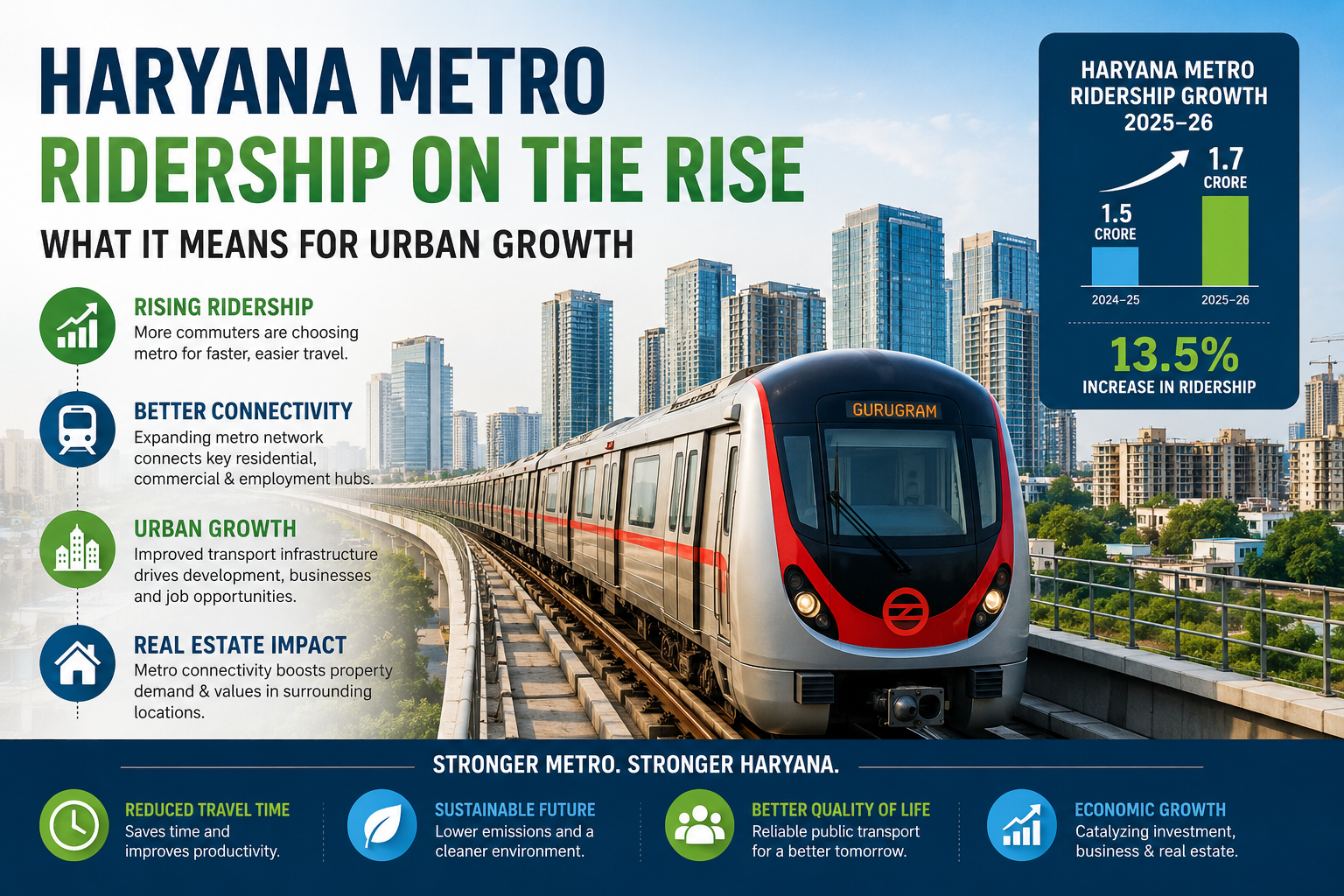
The growth of public transportation is often a strong indicator of how quickly a city is expanding. In Haryana, increasing metro usage is becoming an important part of the state’s urban development story. In particular, the Haryana Metro ridership trend around Gurugram highlights growing dependence on rapid public transport for commuting between residential, commercial and employment hubs.
Recent figures indicate that Rapid Metro Gurugram recorded a 13.5% increase in ridership between April 2025 and February 2026, reaching around 1.7 crore passenger journeys compared with approximately 1.5 crore during the corresponding period a year earlier.
This rise is significant because metro systems do more than move passengers. They can influence how cities develop, where businesses locate, how people choose homes and how real estate markets evolve.
At the same time, it is important to distinguish between statewide Haryana Metro ridership and ridership figures reported for specific systems such as Rapid Metro Gurugram and the Delhi Metro network operating in Haryana. The current ridership growth is particularly relevant to Gurugram, one of Haryana’s fastest-growing urban and employment centres.
So, what does increasing metro usage mean for Haryana’s future?
What Is Driving Haryana Metro Ridership Growth?
Several factors are contributing to greater reliance on metro and rapid-transit systems.
1. Rapid Urbanisation
Haryana has experienced significant urban development, particularly around Gurugram, Faridabad, Manesar and other major growth corridors.
As residential communities expand farther from traditional city centres, commuting becomes increasingly important. Metro connectivity provides an alternative to private vehicles and can make longer daily journeys more manageable.
Gurugram is a particularly strong example. Its combination of residential development, corporate offices, commercial centres and industrial areas creates substantial daily travel demand.
2. Growing Employment Hubs
Gurugram has developed into a major corporate and employment destination. Areas such as Cyber City and Udyog Vihar attract thousands of employees every day.
As employment centres expand, demand for reliable transportation increases. Metro systems can provide predictable connectivity between residential neighbourhoods and business districts.
The proposed Gurugram Metro corridor is designed specifically to strengthen connections between old and new Gurugram and major commercial and employment areas.
3. Increasing Traffic Congestion
Road congestion is another factor pushing commuters toward public transportation.
As vehicle ownership increases, roads become more crowded, particularly during peak office hours. A well-connected metro network can offer commuters a faster and more predictable alternative.
For many urban residents, the decision is no longer simply about choosing between a car and public transport. It is about choosing the most convenient and time-efficient way to reach work, school, shopping and other destinations.
Haryana Metro Expansion and the Future of Connectivity
The rise in Haryana Metro ridership is occurring alongside significant investment in future metro infrastructure.
One of the most important projects is the 28.5-km Gurugram Metro corridor connecting Millennium City Centre to Cyber City, with a spur toward the Dwarka Expressway side. The project has been sanctioned with 27 stations and is being implemented through Gurugram Metro Rail Limited (GMRL), a joint venture between the Government of India and Government of Haryana.
The planned corridor is particularly important because it is intended to connect parts of old and new Gurugram that currently have different levels of public transportation access.
The route includes locations such as:
- Millennium City Centre
- Sector 45
- Sector 47
- Subhash Chowk
- Sector 48
- Sector 72A
- Hero Honda Chowk
- Udyog Vihar
- Basai
- Palam Vihar
- Sector 22
- Cyber City
It also includes a spur toward the Dwarka Expressway area.
The Haryana government’s 2025–26 budget documents also highlighted the 28.5-km Gurugram Metro project and stated that civil construction work was planned to begin during 2025.
This expansion could significantly change the way people move across Gurugram.
How Metro Connectivity Supports Urban Growth
Metro development and urban development usually move together.
When a new transit corridor improves accessibility, the areas around stations can become more attractive for residential, commercial and institutional development.
1. Better Accessibility
Accessibility is one of the most important elements of a successful urban area.
A location connected to multiple transport options can become more attractive to residents and businesses. Metro stations can act as mobility hubs, connecting neighbourhoods with offices, shopping destinations, educational institutions and other parts of the city.
GMRL states that the proposed Gurugram corridor is intended to provide interchange opportunities with other transport systems, including the Yellow Line, railway, bus services, Rapid Metro and proposed RRTS connectivity.
This kind of integration can create a more connected urban environment.
2. Development Around Metro Stations
Metro stations can become focal points for urban development.
Restaurants, retail stores, offices, hotels and residential projects may find station-adjacent locations attractive because of the potential footfall and accessibility.
This can gradually transform areas that were previously less commercially active.
For real estate investors, this makes upcoming metro corridors particularly interesting. However, investors should remember that metro proximity alone does not guarantee property appreciation. Factors such as project quality, road connectivity, infrastructure, demand, construction timelines and surrounding development also matter.
Impact of Haryana Metro Ridership on Real Estate
One of the biggest potential effects of increasing Haryana Metro ridership is its influence on the real estate market.
Metro connectivity can affect both residential and commercial property demand.
Residential Real Estate
Homebuyers increasingly consider transportation connectivity when evaluating a property.
A home located close to a metro station may offer:
- Easier daily commuting
- Better access to employment hubs
- Reduced dependence on private vehicles
- Potentially stronger rental demand
- Convenient access to commercial and social infrastructure
This does not mean every property near a metro station will automatically perform better. But connectivity can become an important supporting factor in the long-term attractiveness of a location.
Commercial Real Estate
The impact can also extend to commercial properties.
Businesses generally prefer locations that employees, customers and clients can reach conveniently. Metro stations can therefore support the development of offices, retail destinations, restaurants and other commercial spaces.
Gurugram’s proposed metro corridor specifically connects several residential, commercial and industrial areas, including Udyog Vihar and Cyber City.
This creates the potential for more integrated commercial growth along the corridor.
Which Areas Could Benefit From Better Metro Connectivity?
Future metro infrastructure could bring greater attention to several parts of Gurugram.
Old Gurugram
Old Gurugram is an important beneficiary of the proposed network because the project is designed to connect it more effectively with newer parts of the city.
Udyog Vihar
Udyog Vihar is a major employment and commercial hub. Better metro connectivity could make commuting to this area easier for employees living in different parts of Gurugram.
Dwarka Expressway Influence Zone
The planned spur toward the Dwarka Expressway side is also important because this region has been experiencing rapid residential and infrastructure development.
Emerging Residential Sectors
Areas located along or near upcoming transit corridors may receive increased attention from homebuyers and investors as connectivity improves.
However, prospective buyers should evaluate the exact distance from a proposed station rather than relying only on the broad phrase “metro connectivity.”
Metro Connectivity and Rental Demand
Another important effect of increasing metro usage can be rental demand.
Professionals often prefer homes that provide convenient access to their workplaces. If a metro station reduces the difficulty of commuting, nearby rental properties can become more attractive.
This can be particularly relevant in employment-driven markets such as Gurugram.
For investors considering rental properties, it is therefore useful to evaluate:
Metro access + employment hubs + residential demand + social infrastructure + rental affordability
rather than considering metro connectivity in isolation.
Sustainable Urban Development
The rise in Haryana Metro ridership also has implications beyond real estate.
Public transportation can support more sustainable urban development by providing an alternative to private vehicle usage.
A strong public transport network can help cities:
- Reduce dependence on private vehicles
- Improve mobility
- Support more compact development
- Connect residential and employment areas
- Improve accessibility
- Support transit-oriented development
GMRL describes the proposed Gurugram corridor as part of a broader effort to provide safe, efficient and affordable public transport while supporting sustainable development.
For a rapidly growing city, this type of infrastructure can become increasingly important.
Metro Expansion Could Reshape Gurugram’s Growth Pattern
Historically, major roads and highways have played a significant role in determining where development occurs.
Metro infrastructure adds another layer to this process.
Instead of development being concentrated only along major roads, future growth can increasingly occur around transit corridors and stations.
This concept is often associated with Transit-Oriented Development (TOD), where residential, commercial and mixed-use development is encouraged around efficient public transportation.
Gurugram’s proposed metro corridor itself envisions connectivity to a developing TOD zone around the Dwarka Expressway.
This could gradually influence how future projects are planned and marketed.
Challenges That Haryana Must Address
While increasing metro ridership is encouraging, infrastructure expansion also comes with challenges.
Last-Mile Connectivity
A metro station is only useful if commuters can easily reach it.
Walking paths, feeder buses, e-rickshaws, cycling infrastructure and parking facilities can all play an important role.
Traffic Around Stations
Poorly planned station areas can experience congestion. Proper traffic management and pedestrian infrastructure will therefore be important.
Integration With Other Transport
Metro should not operate as an isolated system. Integration with buses, railways, Rapid Metro and other mass-transit systems can make the network more effective.
Timely Project Completion
The benefits of planned infrastructure depend heavily on execution. Construction timelines, station accessibility and connectivity to existing transport systems will determine how quickly commuters can benefit.
What Does Rising Haryana Metro Ridership Mean for Investors?
For real estate investors, increasing metro usage can be viewed as an infrastructure signal, rather than a standalone investment guarantee.
Investors should monitor:
- Upcoming metro corridors
- Confirmed station locations
- Existing road connectivity
- Employment centres nearby
- Residential development
- Rental demand
- Commercial activity
- Social infrastructure
- Project completion timelines
- Overall property pricing
A location with strong connectivity, established demand and upcoming infrastructure may have greater long-term potential than an isolated property simply marketed as “near metro.”
The Bigger Picture: Haryana’s Urban Future
The story of Haryana Metro ridership is ultimately a story about changing urban behaviour.
As cities grow, residents need faster, more reliable and better-connected transportation. Rising metro usage indicates that public transport is becoming an increasingly important component of everyday urban mobility.
Gurugram’s upcoming metro expansion could strengthen this trend by connecting residential areas, employment centres, commercial districts and developing growth corridors.
The 28.5-km Gurugram Metro project has been designed with 27 stations and is intended to integrate old and new Gurugram while connecting with other transport networks.
If executed effectively, this infrastructure could contribute not only to better mobility but also to broader economic and real estate development.
Conclusion
The rise in Haryana Metro ridership reflects the growing importance of public transportation in one of India’s rapidly developing urban regions. The reported increase in Rapid Metro Gurugram ridership during 2025–26 provides a useful indication of rising demand for mass transit.
At the same time, Haryana is investing in future connectivity, with the Gurugram Metro corridor expected to create stronger links between Millennium City Centre, Old Gurugram, Udyog Vihar, Cyber City and the Dwarka Expressway area.
For residents, better metro connectivity can mean easier commuting. For businesses, it can improve accessibility to employees and customers. For the real estate sector, it can create new opportunities around emerging transit corridors.
However, metro connectivity should be considered as one part of a broader investment analysis. Property location, pricing, infrastructure quality, employment growth, rental demand and project fundamentals remain equally important.
As Haryana continues to urbanise, the relationship between metro ridership, infrastructure development and real estate growth is likely to become increasingly important.
In short, rising Haryana Metro ridership is not just a transportation trend—it is a signal of how the state’s cities are evolving and how future urban growth may be shaped around better connectivity.
FAQs
1. What is driving Haryana Metro ridership growth?
Growing urbanisation, employment hubs, traffic congestion and expanding public transportation infrastructure are among the factors contributing to greater metro usage.
2. How will metro expansion affect Gurugram real estate?
Improved connectivity can increase the attractiveness of residential and commercial locations near metro corridors, although property performance depends on several factors beyond metro access.
3. Which Gurugram Metro project is currently important for future connectivity?
The 28.5-km Millennium City Centre–Cyber City corridor, including a spur toward the Dwarka Expressway area, is a major planned Gurugram Metro project.
4. Does buying property near a metro station guarantee appreciation?
No. Metro proximity can be a positive factor, but investors should also assess pricing, demand, infrastructure, development quality and the actual distance from the station.
5. Why is metro connectivity important for urban growth?
Efficient public transport can improve accessibility, connect employment and residential areas, support commercial activity and encourage more sustainable urban development.